


Most marketing teams treat FAQ sections as an afterthought. A few generic questions bolted onto the bottom of a service page. Written to look thorough. Not to actually answer anything.
That’s a visibility problem — and in 2026, it’s becoming an expensive one.
People Also Ask is the most popular SERP feature across industries, appearing in 96% of search queries.
Clutch
And when Google surfaces an AI Overview, People Also Ask (or PAA) appears alongside it the vast majority of the time. This isn’t a coincidence. PAA and AI Overviews are drawing from the same well — Google’s understanding of how people actually think through a topic.
Which means if your FAQ content isn’t built around that understanding, you’re not just missing a SERP feature. You’re missing the architecture of modern visibility.
What People Also Ask (PAA) Questions Actually Are
People Also Ask questions aren’t keyword opportunities. They’re not gaps to fill or boxes to check. They are a cognitive map — a literal diagram of how your buyer’s brain is working through a problem.
Here’s where most content strategies get it wrong.
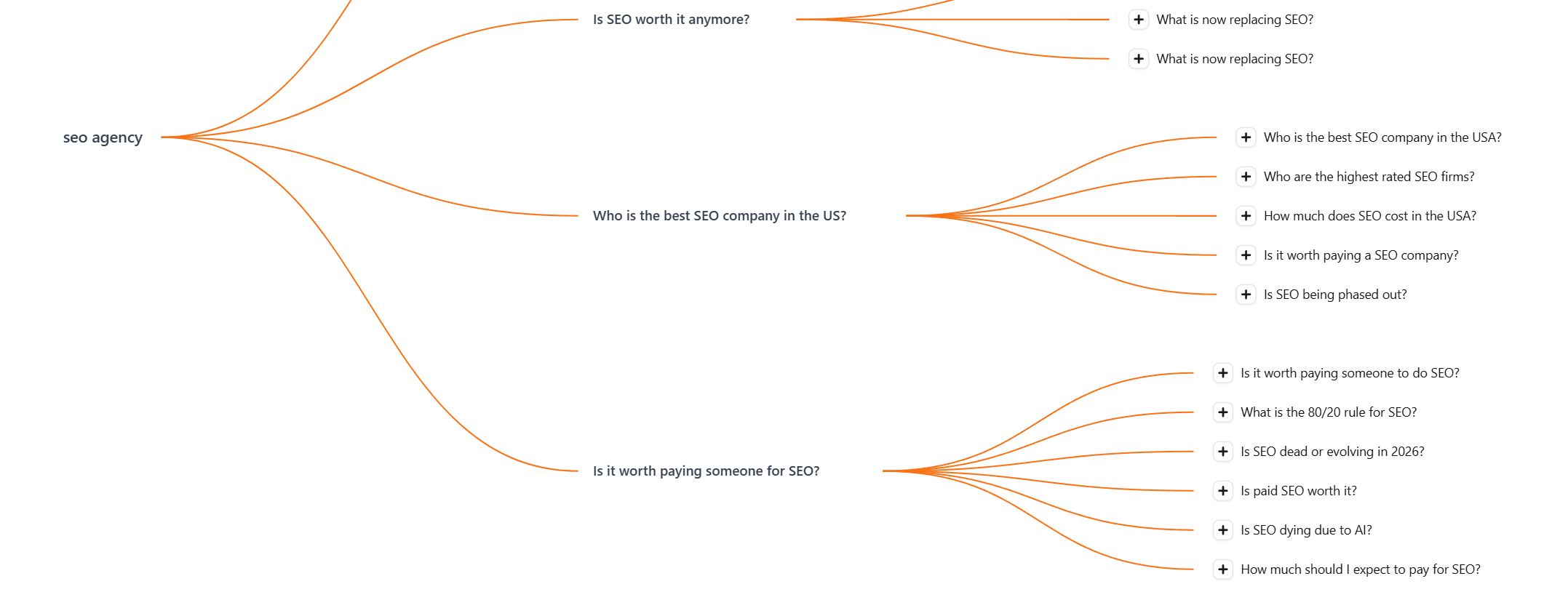
When someone searches a topic, Google doesn’t just return an answer. It surfaces the next question. And the question after that. The branching structure you see in tools like AlsoAsked isn’t random — it’s Google’s model of the actual decision sequence real people follow when they’re trying to understand something, evaluate options, or make a choice.
That branching hierarchy tells you more than any keyword tool can. It tells you the sequence of reasoning. The concerns that surface at each stage. The comparisons people run before they commit. The fears underneath the questions they’re asking out loud.
For marketing teams, this reframes how you brief content entirely. You’re not guessing at what to cover. You’re reading the decision path your buyer follows — before they ever reach your site. Then you build your content strategy around that.
The SEO Case: Building Topical Authority Around Human Reasoning
Traditional keyword research tells you what people search. People Also Ask tells you how they search — the sequence, the logic, the progression from awareness to decision.
That distinction matters enormously for topical authority.
Google doesn’t evaluate pages in isolation. It evaluates whether your site comprehensively covers a topic — and whether the content ecosystem you’ve built reflects how people actually think through that subject. When your content maps to the branching question hierarchy PAA reveals, you’re not just targeting keywords. You’re building a content architecture that mirrors real human reasoning.
That’s what topical authority actually means. Not more pages. Not more keywords. A content ecosystem that answers the right questions, in the right sequence, connected through deliberate internal linking that reinforces the topical relationships Google already understands.
The AI Retrieval Case: Questions Are the Format LLMs Prefer
AI engines don’t retrieve pages. They retrieve passages.
ChatGPT, Perplexity, Gemini, Claude — they segment your content into chunks, evaluate the semantic clarity of each chunk, and pull the ones that best answer the query at hand. Vague, meandering paragraphs get skipped. Clear question-and-answer structure gets retrieved.
PAA-structured content is exceptionally well-suited for this. A question as a heading, followed by a direct and well-scoped answer, is precisely the format AI retrieval systems are designed to work with. It’s not a coincidence that the content showing up most consistently in AI-generated answers tends to be the content that’s most clearly organized around real questions.
At Trebletree, we use Scrunch to analyze how LLMs are actually responding to queries in our clients’ industries — including the specific questions AI engines ask within their own answers and how they structure the information they surface. The pattern is consistent: sites that organize content around real, clearly structured questions appear more often, more accurately, and more completely in AI-generated answers. Sites that don’t get skipped entirely — even when their rankings are strong.
Ranking and retrieval are two different outcomes now. PAA-structured content helps you achieve both.
How PAA Shapes Content Strategy: From Topic Gaps to FAQ Schema
This is where People Also Ask becomes a content planning tool, not just a research one.
The branching hierarchy surfaces questions your existing content may not be answering at all — entire subtopics that belong in your content strategy but haven’t been identified through traditional keyword research. Those gaps become new content opportunities: supporting pages, blog articles, resource content that deepens your topical coverage and strengthens the ecosystem around your core pages.
And within existing pages, PAA data identifies exactly what FAQ sections should cover — the specific questions that deserve a structured answer, in the right context, at the right stage of the buyer journey. Not generic questions added for appearances. Questions your actual audience is asking, mapped to the pages where they’re most relevant.
Then we kick this up a notch by coordinating FAQ sections with FAQ schema. Structured markup tells Google — and AI systems — precisely what the question is and what the answer is. That clarity reduces interpretive work and increases the likelihood your content gets pulled into featured positions, AI Overviews, and generative answers.
This is the full loop: PAA research identifies the questions, content strategy maps them to the right pages, FAQ schema signals their relevance explicitly. Each layer compounds the one before it.
Optimizing for Human Connection, Not Search Engines
Here’s a reframe worth sitting with.
Algorithms change constantly. Google’s ranking systems evolve. AI engines update their retrieval logic. What worked two years ago — sometimes two months ago — doesn’t work the same way today.
But human decision-making doesn’t change.
And that’s not a coincidence — it’s the point. Google’s goal has always been to better serve their users through the decision-making process that search supports. The algorithm evolves, but what it’s optimizing for stays the same: helping a person find the answer they need and move forward with confidence. Implementing People Also Ask data into your content strategy is integrating that same consumer behavior directly into how you build content. It’s not chasing the algorithm. It’s aligning with what the algorithm has always been trying to do.
That’s why it compounds. And that’s why it will always pay off.
Here’s what makes PAA data so valuable in practice: the same query means something completely different depending on where someone is in their decision process. Someone searching “best franchise SEO agency” at the research stage is in a completely different mindset than someone searching that same phrase the week before a contract decision. Same words. Completely different need.
PAA captures that complexity. The branching question hierarchy surfaces not just what people ask — but the emotional and motivational context underneath the questions. AlsoAsked calls this the Quantum Superposition Query Principle — the idea that a single query carries multiple layers of intent simultaneously, and that content strategy built around decoding those layers outperforms content built around surface-level keywords alone. It’s worth a read if you want to go deeper.
The practical application is straightforward. When we build content strategy around PAA data at Trebletree, we’re not just mapping questions to pages. We’re mapping questions to where a buyer actually is in their decision process — and making sure the answer meets them there.
That’s the difference between content that ranks and content that converts.
The People Also Ask Tools We Use at Trebletree
At Trebletree, our go-to PAA research stack is AnswerThePublic and AlsoAsked. They answer different questions and they’re most powerful in combination — but what sets them apart is worth understanding before you decide how to use them.
AnswerThePublic
AnswerThePublic is the broadest view of how people search a topic — and it’s genuinely one of the most powerful content strategy tools available.
What makes it next level is the sheer scope of data it pulls together in one place. It goes well beyond PAA questions, surfacing how people search across search engines, AI platforms, social media, and shopping — giving you a multi-dimensional picture of how your topic lives across every discovery environment your audience uses.
Here’s what we use it for at Trebletree:
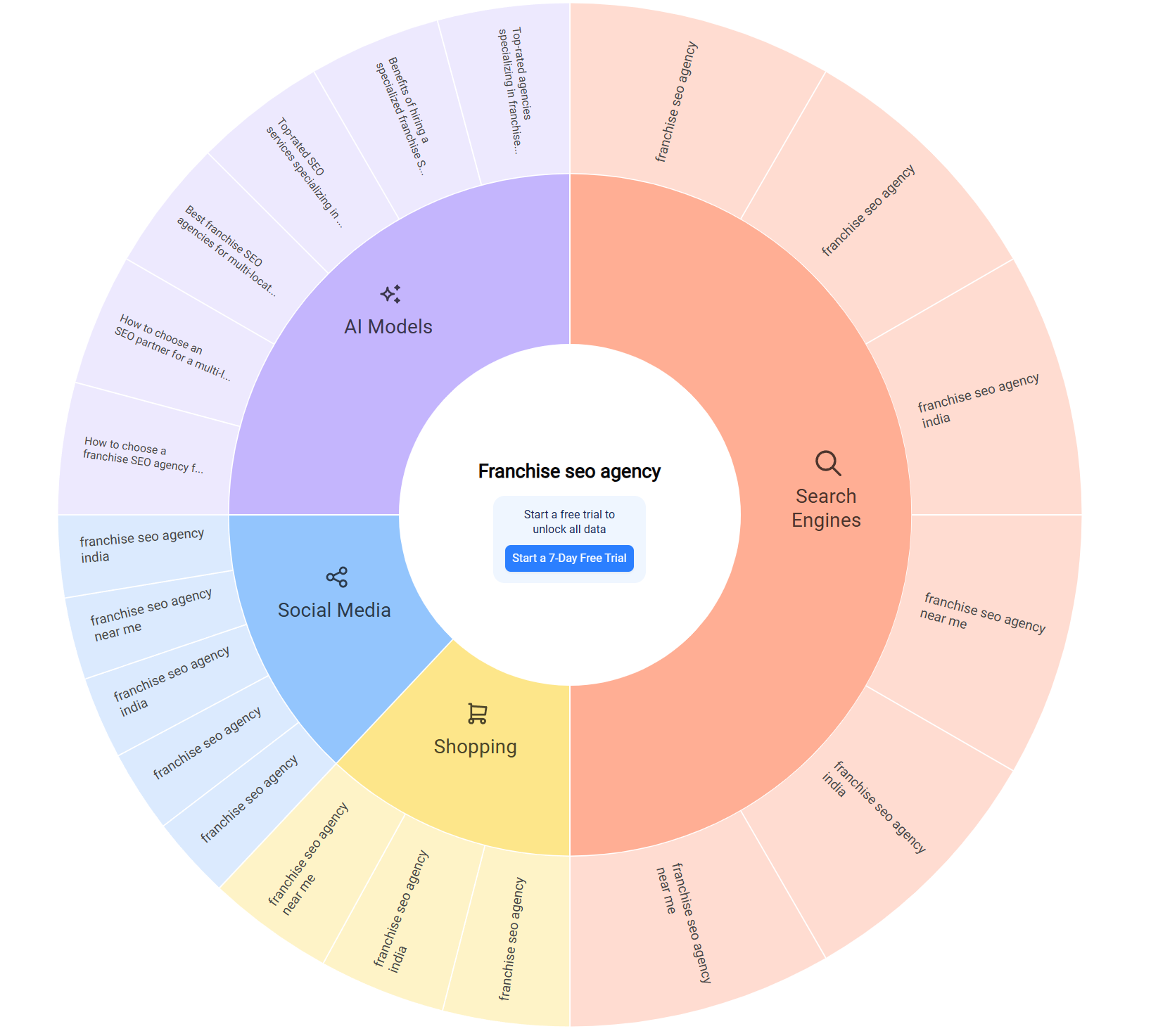
Content Ideas — The Circle Graph. The visual sunburst diagram is where we start every content strategy engagement. It organizes questions, prepositions, comparisons, and variations around a core topic into a single view — and the density of each section immediately tells you where the content opportunity is. This becomes the foundation of our hub and spoke model.
PAA Query Fanout. Pulls PAA data organized by question type — who, what, where, when, why, how. We use this to map questions directly to buyer journey stages before a single word of content is written.
AnswerThePublic doesn’t stop there. To paint a picture of the full search landscape, they also provide:
- AI Prompts — Gemini & ChatGPT Data (Beta). This is where AnswerThePublic is moving into genuinely new territory. It now surfaces actual prompts people are using in Gemini and ChatGPT — so you can see how your topic is being explored in AI environments, not just traditional search. For content strategy in 2026, this is increasingly essential.
- Organic Search Data. Search query data organized by phrasing and question structure — with volume, CPC, and trend data on paid plans. The sentiment and brand mention data from AI queries on the paid plan adds another layer that feeds directly into competitive and content strategy.
- CompoSEO. Built-in content generation that turns question data into briefs and drafts. Useful for accelerating the move from research to execution without losing the strategic foundation.
The reason we rely on AnswerThePublic as our starting point: it gives us the full landscape before we go deep. Every content strategy decision we make is grounded in what the data actually shows — not assumptions about what the audience wants to know.
AlsoAsked
Where AnswerThePublic gives us breadth, AlsoAsked gives us depth. It’s a more focused tool — purpose-built for PAA hierarchy — and it does that one thing exceptionally well.
What sets AlsoAsked apart is the branching tree structure. It doesn’t just show you what people ask. It shows you what they ask next — the exact sequence of questions a searcher follows from initial query to final decision. That decision path is what we use to build content that mirrors how buyers actually think, not how we assume they think.
The reason AlsoAsked earns its place in our stack alongside AnswerThePublic: the hierarchy is irreplaceable. The branching structure shows the cognitive map. And the cognitive map is what makes content strategy actually strategic.
Scrunch
Scrunch is where PAA strategy extends into AI search — and where the research loop closes.
At Trebletree, we use Scrunch to track how LLMs are referencing our clients and how they’re framing answers to the questions real users are asking. Over time, we can see how those answers evolve — which sources are being cited, how the framing shifts, where our clients’ content is showing up and where it isn’t.
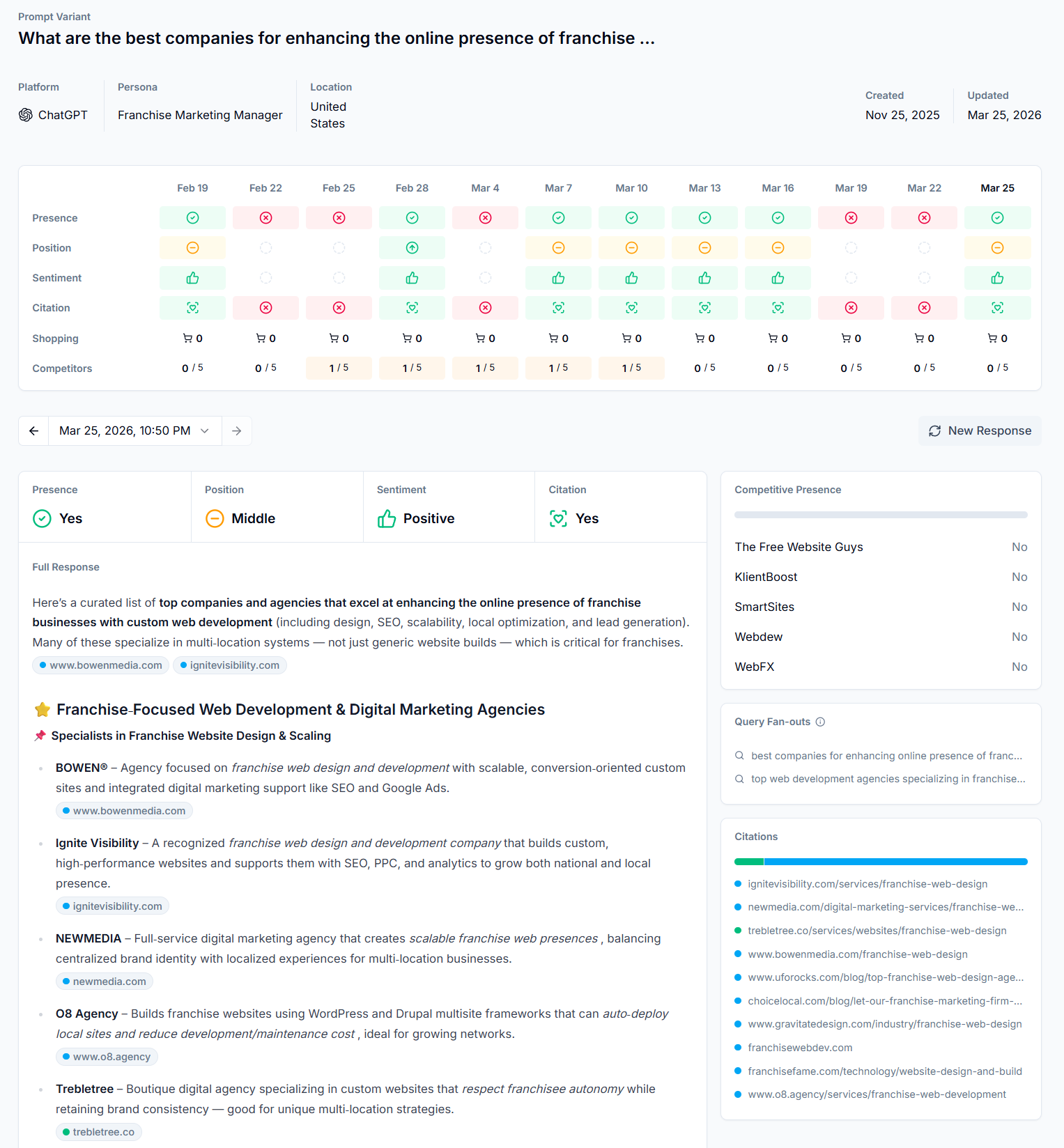
That framing intelligence feeds directly back into content strategy. The same way PAA data tells us which questions to answer in search, Scrunch tells us which questions AI engines are already answering — and how. When there’s a gap between what an LLM says about a topic and what a client’s content actually communicates, that gap becomes a content opportunity. New pages, updated FAQs, clearer entity signals — all driven by what we’re seeing in real AI answers.
This is PAA strategy applied to AI search. The questions are the same. The data source is different. The content response is identical: answer the right questions, in the right structure, on the right pages.
Trebletree’s PAA Workflow
Here’s our workflow for integrating People Also Ask data into our content strategy.
1. Map the topic landscape with AnswerThePublic – Start with the full breadth — every question, comparison, preposition, and AI prompt variation around your core keyword. Use the circle graph to identify the hub and spoke structure. Note which subtopics are densely connected and which are thin.
2. Drill into the PAA hierarchy with AlsoAsked – Map the branching question tree for your core keyword and top subtopics. Use Deep Search to go three levels in. This is where the high-intent content gaps live — and where the actual decision path your buyer follows becomes visible.
3. Cluster by buyer journey stage – Group all questions from both tools into awareness, evaluation, and decision stages. You’re not just identifying what people ask — you’re understanding where they are when they ask it.
4. Audit existing content against the full map – Cross-reference the complete question map against your current content. What’s being answered well? What’s missing entirely? This step converts PAA research into a prioritized content gap analysis.
5. Build out the content ecosystem – New gaps become new content — supporting pages, blog articles, resource content that deepens topical coverage and strengthens the hub. Existing pages get updated to answer the questions they’re missing. Every piece connects back to the pillar through deliberate internal linking.
6. Coordinate FAQs to the right pages – Use PAA data to determine which FAQ sections belong on which pages — the right questions at the right stage of the buyer journey, mapped to the pages where they’re most contextually relevant.
7. Apply FAQ schema – Every Q&A block gets structured markup. This makes the signal explicit to Google and AI systems — reducing interpretive work and increasing the likelihood your content gets pulled into featured positions, AI Overviews, and generative answers.
8. Monitor AI framing with Scrunch – Track how LLMs are answering questions in your space and how they’re framing those answers over time. Where the AI framing diverges from your content — or where your content isn’t being retrieved — that’s your next content priority. The loop starts again.
What This Means for Your Content Strategy
The brands winning visibility in 2026 aren’t the ones publishing more content. They’re the ones whose content is structured clearly enough, comprehensively enough, and human enough to be retrieved — across every system doing the evaluating.
PAA data gives you the roadmap. The questions are already there. The decision path your buyer follows is already mapped. The branching hierarchy Google has built around your topic is already visible — if you know where to look and what to do with it.
At Trebletree, our content strategy engagements are built around this framework — starting with PAA research, mapping it to buyer journey stages, and building content ecosystems that perform in both traditional search and AI retrieval environments. Our SEO audits always include a PAA and FAQ analysis: where question-based content is missing, where existing FAQ content isn’t structured for retrieval, and where schema is absent or incorrect.
If you’re ready to build a content strategy around how your buyers actually think — explore our content strategy services or get started with an SEO audit to see where your current content stands.