


What Retail Franchisors Need in a Website
- The biggest website design risk for retail franchises with an e-commerce presence is building a site where the brand’s own online store competes with franchisee locations for local product searches. Getting the location page architecture right is the primary fix.
- Every franchisee location needs its own page with product-specific content, not just an address in a store finder. The more specific the product and service content on each location page, the more local searches that page can rank for.
- Google’s Products feature within GBP is underused by retail franchisors. Adding individual products to each location’s profile creates additional search signals and gives the listing more visual presence in search results.
- The franchise development section needs to show prospective franchisees that the brand has real consumer traction. A retail candidate evaluates the consumer-facing website as evidence that the business model works before they ever look at the FDD.
- Location page content should reflect what makes each store genuinely worth visiting, specific product specialties, fitting or consultation services, local staff expertise, not a copy of the brand template with a different address.
Retail franchise website design has a specific structural challenge that service-based franchise categories do not face in the same way. When a brand has an e-commerce presence and a network of franchise locations, the website has to be built so that local product searches lead customers to the nearest franchisee, not to the online store. That sounds straightforward. In practice, most retail franchise websites get it wrong, and franchisees end up watching their own brand’s website send customers to a shopping cart instead of through their door.
Here is how to build it correctly.
The In-Store vs. Online Traffic Problem
A customer in a franchisee’s market who searches for the brand’s signature product category should land on the local franchise location page, not on the brand e-commerce page. When the brand website’s product pages outrank individual location pages for local searches, the franchisee loses in-store revenue to a channel they cannot control and do not benefit from.
The fix is not complicated but it requires deliberate architecture. Location pages need enough product-specific and geography-specific content to rank for local product searches. The internal link structure of the brand website needs to pass authority to location pages in a way that signals their local relevance to Google. And the site structure needs to make it easy for Google to understand that location pages serve specific geographic markets rather than a national audience.
This is the same structural principle that applies across multi-location franchise SEO. Our multi-location SEO playbook covers the technical architecture in depth. For retail franchises specifically, the stakes are higher because every local product search that lands on the brand e-commerce page rather than a location page is a direct revenue miss for a franchisee.
Location Pages That Do Real SEO Work
A store finder that returns an address and hours is not a location page. It is a directory listing with a map. A retail franchise location page that actually supports local search visibility includes the specific product categories available at that location, any unique services the location offers (fittings, consultations, custom orders, alterations), the geographic area the store serves, and enough locally specific content to distinguish it as a real local business rather than a brand template copy.
What Every Retail Franchise Location Page Needs
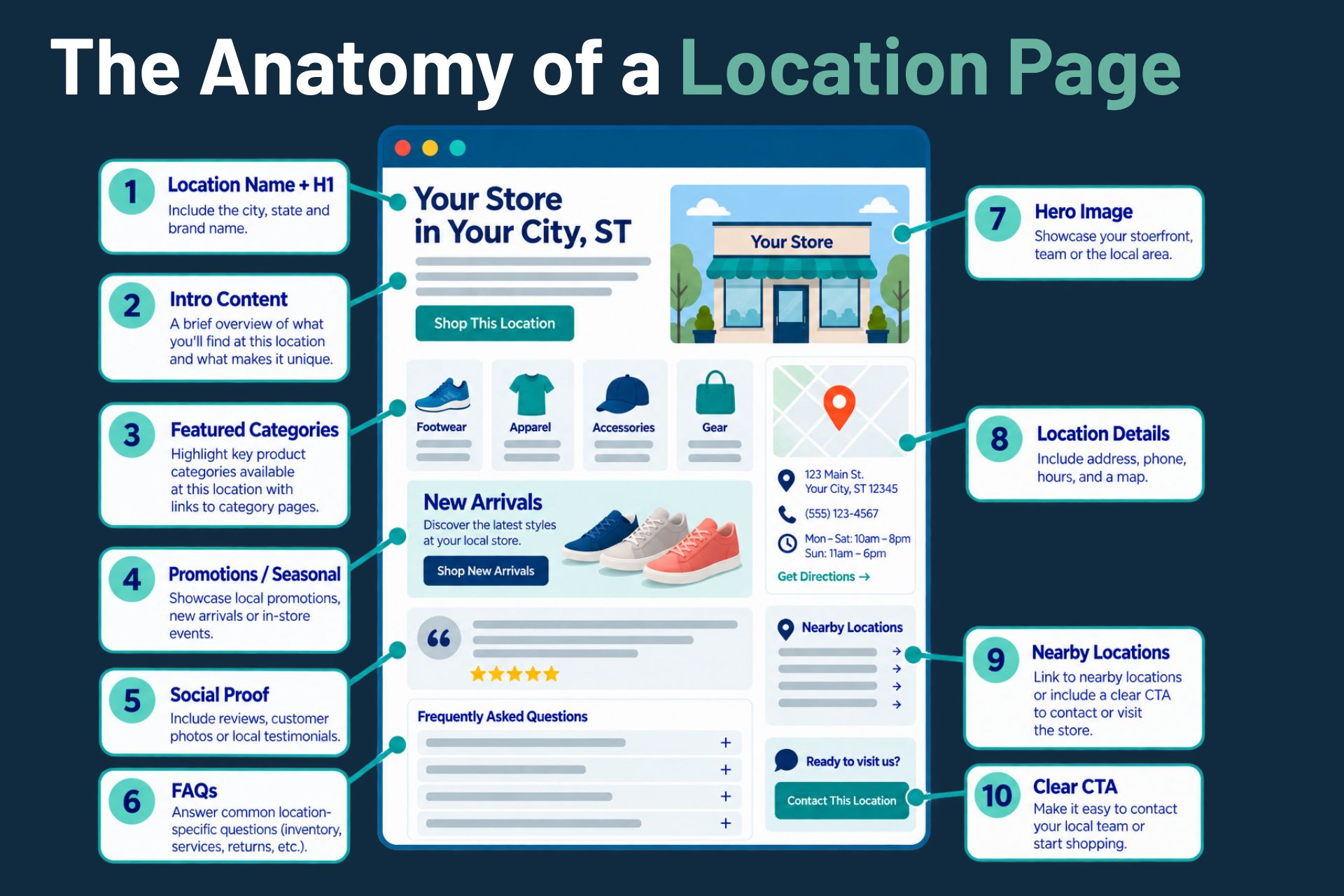
A store finder that surfaces an address and a phone number is doing the minimum. A location page that actually drives in-store traffic and supports local search visibility has ten components. Most retail franchise location pages have three or four of them.
Location Name and H1
The page headline should include the store name, city, and state. “Your Store in Manchester, NH” tells Google and the visitor exactly what page they are on before they read anything else. A brand name alone does not carry enough geographic signal to rank for local product searches.
Intro Content
A brief overview of what shoppers will find at this specific location and what makes it worth visiting. This is where locally specific language lives: the neighborhood the store is in, any specialties or exclusives at this location, how long it has been open, and anything that distinguishes this store from others in the system.
Featured Categories
The key product categories available at this location, linked to local category pages where they exist. Not a copy of the full national product catalog. The categories this location actually stocks, named the way a local customer would search for them.
Promotions and Seasonal Content
Local promotions, new arrivals, or in-store events specific to this location. A national sale banner does not serve this purpose. Locally relevant promotional content keeps the page current, signals to Google that the location is active, and gives a returning visitor a reason to engage with the page rather than bounce.
Social Proof
Customer reviews, local testimonials, or customer photos specific to this location. National review aggregates do not build the local trust that converts a nearby shopper. The social proof that matters here is from people in this market who visited this store and had a good experience.
FAQs
Location-specific questions about inventory, services offered at this store, return policies, parking, and anything else local customers commonly ask. These also capture long-tail local search queries that the main page content does not directly target.
Hero Image
A photo of the actual storefront, the team, or the local area. Customers deciding whether to visit a physical retail location are forming an impression of whether the store feels accessible and worth the trip. A photo of the actual store does that in a way a brand lifestyle image does not.
Location Details
Address, phone number, hours including weekend hours, and an embedded map. These need to match the GBP exactly. Any discrepancy between the location page and the GBP creates a consistency signal that search engines penalize and that customers find confusing.
Nearby Locations
Links to other franchise locations in the region. This serves customers who might be closer to a different store and keeps them in the brand ecosystem rather than sending them to a competitor. It also supports internal linking across location pages, which helps the overall site architecture.
Clear CTA
A direct path to contact the store or start shopping, visible at the top and bottom of the page. “Contact This Location” or “Shop This Location” with a link that goes somewhere immediately actionable. Not a general brand contact page. Not a link to the national e-commerce store.
The Products Feature in GBP
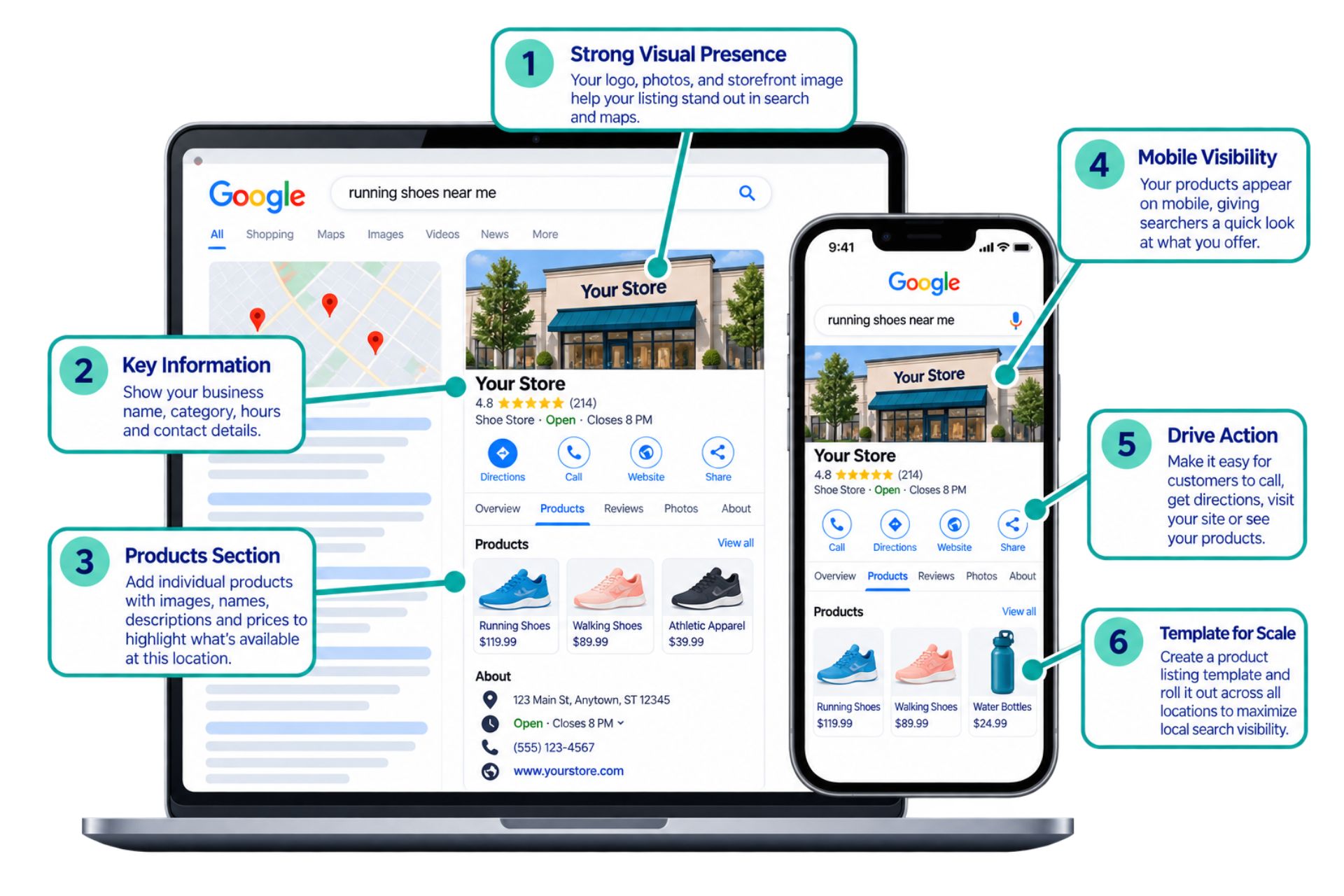
Google’s Products section within GBP is one of the most underused tools in retail franchise local SEO. Adding individual products, with names, descriptions, and prices where applicable, to each location’s GBP creates additional search signals around specific product searches and gives the listing more visual presence in the map pack. For a franchise system with a defined product catalog, this is a templatable improvement that can be rolled out across all locations without requiring custom work at each one.
The franchisor who builds a product listing template and distributes it to franchisees, or better, implements it centrally through GBP bulk management, gives every location a local search advantage that competitors without this in place are not capturing. Explore our guide on optimizing Google Business Profiles (GBP) for franchises.
Detail Pages That Support Both Audiences
Retail franchise websites typically need service and product content at two levels, and those pages should not compete with each other for the same searches.
Brand-level product and category pages establish authority in each product area and support national organic visibility. They are written for the customer who discovers the brand through a broad search and wants to understand what the franchise offers.
Location-level content serves local search. A customer searching “arch support insoles in [city]” or “running shoe fitting near me” needs to find the specific franchisee location serving their market. Location pages with product-specific and geography-specific content capture those searches. Brand-level category pages do not.
The Franchise Development Angle
A retail franchise candidate evaluates the consumer-facing website as evidence of business model viability before they look at anything else. Strong local search visibility for existing locations, a professional and consistent brand presentation, and well-built location pages that show the brand knows how to drive in-store traffic all signal to a prospective franchisee that the marketing infrastructure is real. A weak consumer-facing digital presence raises the opposite question before the development conversation even starts.
We have written more directly about how the consumer website factors into franchise development. For retail franchisors specifically, the product-level local search visibility of existing locations is one of the strongest signals a prospect can evaluate.
How Trebletree Can Help
We design and build retail franchise websites with the location page architecture and product-level content structure that drives in-store traffic without cannibalizing e-commerce. If you are a retail franchisor whose website is not producing consistent location-level visibility, or whose location pages are losing local product searches to the brand’s own online store, we can show you exactly where the gaps are.
See how we approach franchise website design
Frequently Asked Questions
How do you prevent a brand e-commerce site from competing with franchise locations in local search?
Build location pages with enough product-specific and geography-specific content to rank for local product searches in each franchisee’s market. Structure the brand website’s internal links so they pass authority to location pages and signal their local relevance to Google. Make sure the technical architecture clearly distinguishes location pages as serving specific geographic markets rather than a national audience. This is an architecture decision, not a content shortcut, and it needs to be built into the site structure from the start.
What should a retail franchise location page include?
The specific product categories available at that location, any unique services offered such as fittings or consultations, the geographic area the store serves, staff expertise relevant to the primary product categories, hours and contact information with a clear path to visit or book an appointment, and any locally relevant content that distinguishes this location from the brand template. The more specific the product and service content, the more local searches the page can rank for.
Should retail franchise location pages be managed centrally or by franchisees?
Core architecture, brand information, and product category content should be managed centrally. Local content such as staff profiles, local specialty areas, and any community or neighborhood references can be contributed by franchisees within a structured framework. Franchisees who understand that their location page directly affects their in-store traffic are generally motivated to contribute local content when the process for doing so is simple and clearly scoped.
How does the Google Products feature help retail franchise locations?
Adding products to each location’s GBP creates additional search signals around specific product searches and gives the listing more visual presence in local search results. For a franchise system with a defined product catalog, this can be templated and rolled out centrally rather than configured location by location. It is one of the more underused local search advantages available to retail franchisors and produces meaningful results with relatively modest effort.
What does retail franchise website design typically cost?
Cost varies significantly based on the number of locations, the complexity of product catalog integration, and whether e-commerce and franchise location functionality need to coexist on the same platform. Our piece on franchise website costs covers what drives the range at different scales.