


What Franchisors Need to Know About Child Enrichment Website Design
- Parents research and compare before they trust anyone with their kid, so a child enrichment website has to lead with proof (credentials, safety practices, local reviews).
- A trial class or tour is a much better first ask than full enrollment, since most parents are not ready to commit to a semester on a first visit.
- Programs organized by age, not by brand-specific class names, match how parents actually search and think.
- Each location needs its own schedule, instructors, and reviews, because the owner and their community are what turn research into enrollment.
Choosing an enrichment program is one of the more careful purchases a parent makes. It is recurring, it involves their child’s safety and development, and it usually competes with a sibling’s soccer practice and a full family calendar. Parents do their homework, and a good share of that homework happens on your website.
That changes what the website needs to do. A family entertainment site is built to get a parent to a booking. A child enrichment site is built to earn enough trust that a parent signs up for a trial class, and then earn enough more that the trial turns into weekly enrollment. Add a franchise structure, where classes, instructors, and schedules differ from one location to the next, and the site has a lot of work to do.
If you have read our posts on retail franchise website design and home service franchise website design, the architecture will look familiar. The emphasis is different here, so let’s walk through it.

How Parents Research Enrichment Programs for Their Kids
The process usually looks similar to this:
- A parent searches for something nearby that fits their child’s age and interests.
- They open a handful of results, look for the schedule, look for the instructors, and read the reviews from other parents.
- Then they contact one or two programs, often by filling out a form, and ask about a trial.
Nearly every step in that path is a question a website can answer before a human ever does. What ages do you serve? What does a class look like? Who teaches it? Is it safe? What does it cost? When can we try it? The franchise sites that convert are the ones that answer those questions clearly, in the parent’s language, at the location level.
Our child enrichment franchise SEO guide covers how parents find these pages. This post covers what they should find when they arrive.
Lead With Trust, Then Ask for the Trial
Trust signals belong near the top of every page a parent might land on. That means instructor credentials, background check and safety practices, class size, curriculum approach, and reviews from local families.
Once trust is established, the call to action should be a low-commitment step. A free or discounted trial class, an open house, or a brief tour request all work better than “Enroll Now” for a first visit. Parents are not ready to commit to a semester. They are ready to see the room and meet the teacher.
Make that path visible on every page, and make sure it sends the parent to the correct location. A form that asks for a zip code and then sorts out the right franchisee behind the scenes is easier than a dropdown with 80 locations.
Organize Programs by Age, Then by Location
Parents think in age groups before they think in program names. A site organized around “Our Programs” with a long list of brand-specific class names will lose a parent who just wants to know what is available for a four-year-old.
Build the program structure around age ranges first (infants and toddlers, preschool, elementary, and so on), with brand-specific program names underneath. Each national program page explains the curriculum and the benefits. Each location page then shows which of those programs that specific franchisee offers, since not every location runs every class.
That split also protects your SEO. National program pages build authority for the brand and its methods. Location pages capture the local searches that actually produce trial signups.
The Anatomy of a Child Enrichment Location Page
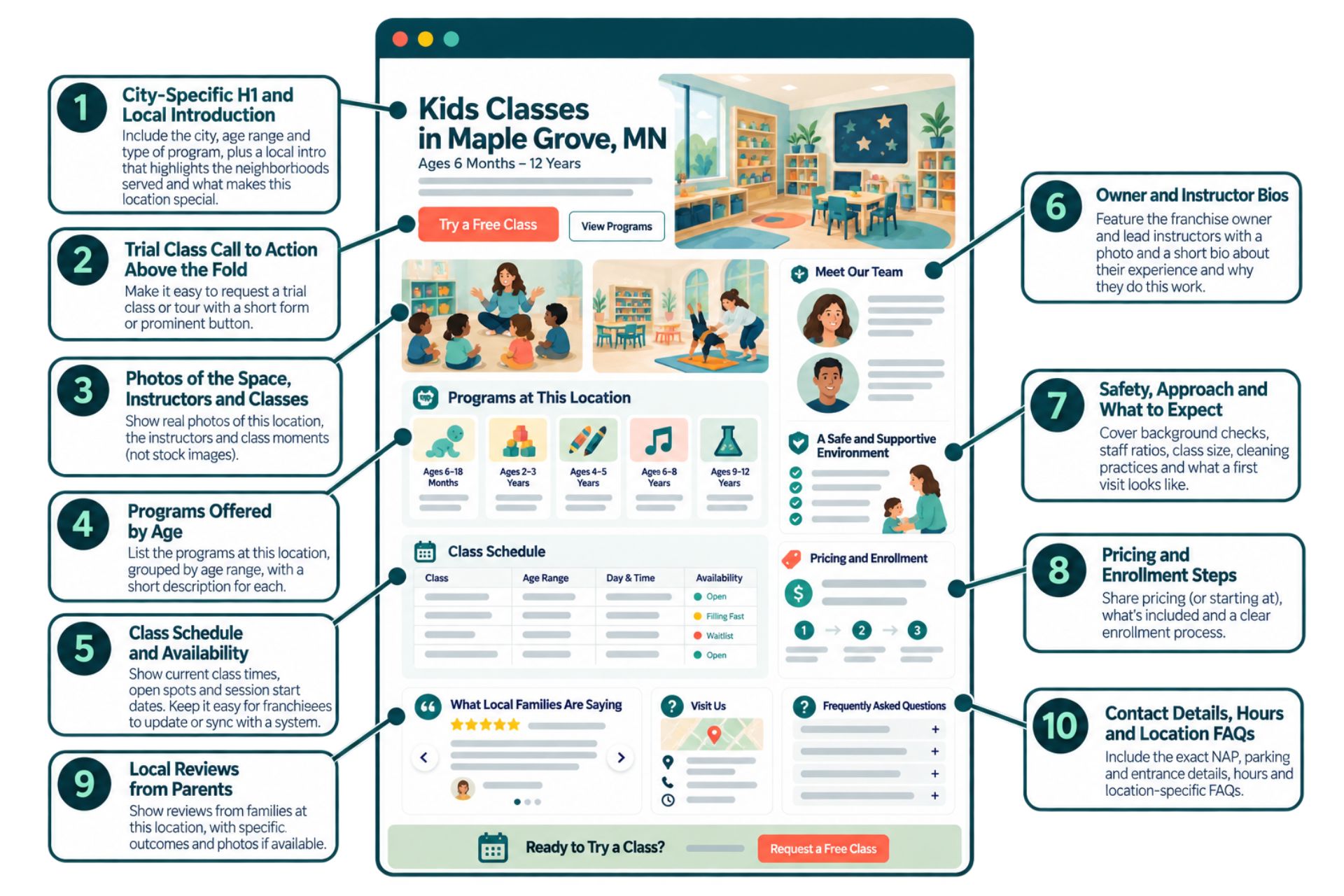
This is the page that converts. It is also the page most franchise sites get wrong, usually by treating it as a contact card. Here is what should be on it.
1. A City-Specific H1 and Local Introduction
Name the city, the age range, and the type of program in the H1. Follow it with a short introduction in the owner’s voice that mentions the neighborhoods served and what makes this location a good fit for local families.
2. A Trial Class Call to Action Above the Fold
Put the trial class or tour request button at the top of the page and repeat it near the bottom. Keep the form short. Name, email, child’s age, and preferred day is enough to start a conversation.
3. Photos of the Actual Space, Instructors, and Classes
Parents want to see where their child will spend time and who will be leading it. Photos of the actual classroom, candid class moments (with proper permissions), and the instructors themselves do more to build trust than any paragraph of copy.
4. Programs Offered, Organized by Age
List the programs available at this location, grouped by age range. Include a sentence about what a child will do and learn in each one, and link to the national program page for the full curriculum.
5. Class Schedule and Availability
Show current class times, open spots, and session start dates. A schedule that is out of date is worse than no schedule, so give franchisees an easy way to update it, or connect the page to the scheduling system so it updates itself.
6. Owner and Instructor Bios
Parents are choosing people, not a brand. A short bio of the franchise owner and the lead instructors, with a photo and a line about why they do this work, makes a location feel like a neighborhood business backed by a national system. That is the balance families are looking for.
7. Safety, Approach, and What to Expect at a First Class
Cover background checks, staff-to-child ratios, class size, cleaning practices, and what a first visit looks like. This is often the section that tips a hesitant parent into a trial.
8. Pricing and Enrollment Steps
Be as transparent as the franchise model allows. Even a range or a “starting at” figure, along with a clear explanation of how enrollment works, prevents the drop-off that happens when parents cannot tell whether a program fits their budget.
9. Reviews From Local Parents
Location-specific reviews carry far more weight than brand-wide ratings. A parent in the same town describing what their child gained from the program is the most persuasive content on the page.
10. Contact Details, Hours, and Location FAQs
Keep the name, address, and phone number matching the Google Business Profile exactly. Add parking and entrance details, and answer the questions specific to this location. Mark the FAQs up with schema so search engines and AI tools can pull them cleanly.
The template should also generate LocalBusiness structured data from the same fields that fill in the page. That keeps the data accurate across every location without manual work.

Make the Parent Experience Feel Local
The hardest balance in franchise design is keeping the brand consistent while letting each location feel like it belongs to its community. In child enrichment, that balance matters even more, because parents are handing over their kids and want to know a person is accountable.
The answer is a template with locked brand elements (layout, navigation, colors, program descriptions, safety standards) and open local fields (owner bio, photos, schedule, events, local reviews, community involvement). Franchisees get room to be visible in their own market, and the franchisor keeps the parts that protect the brand.
Our franchise web design work is built around exactly that split, and our breakdown of what a franchise website costs shows where a project like this puts its budget.
Keep Franchise Development Separate
Prospective franchisees have different questions than parents. They want to know about the model, the support, the investment, and the ownership experience. Give them their own section with a dedicated inquiry path, and keep it out of the way of the parent journey. Both audiences convert better when the site does not ask them to sort through content meant for someone else.
Prepare for AI Search
Parents are increasingly asking AI tools for recommendations like “the best preschool enrichment classes near me.” The sources those answers draw from are well-structured, location-specific pages with clear program details and reviews. A well-built franchise site produces exactly that content. We wrote more about the risk of getting this wrong in why franchise brands are invisible to AI search.
Building a Child Enrichment Franchise Website With Trebletree
We design and build franchise websites that earn parent trust at the location level and scale as your system grows, with the SEO planned in from the start. If your website is not converting research into trial classes, we would love to talk.
Frequently Asked Questions
What should a child enrichment franchise website include?
The essentials are a homepage, national program pages organized by age, a location finder, one page per location, safety and approach information, reviews, and a separate franchise development section. The location pages carry most of the conversion weight.
How do you show different programs at different franchise locations?
Build the program pages once at the national level, then let each location page display only the programs that franchisee offers. A template with selectable program fields keeps this simple to manage.
Should the site list pricing?
When the franchise model allows it, yes. Even a starting price or a range helps parents self-qualify and reduces low-intent inquiries. If pricing varies by location, let each franchisee publish their own figures on their page.
How do we handle photos of children on the website?
Get written permission from parents before publishing any photo of a child, and set clear photo guidelines in the franchise system so every location follows the same standard. Photos of instructors and empty classrooms are a good starting point.
Can Trebletree work with our existing franchise platform?
We work with franchisors on both new builds and rebuilds, and the first step is usually a look at how your current structure supports location pages. From there we can recommend whether to improve what you have or start fresh.