


Franchise SEO gets complicated fast.
Not necessarily because franchise websites are larger than other websites. The challenge is that one site has to support two very different goals at the same time.
The corporate brand needs consistency, authority, and control over the overall customer experience. Individual locations also need enough unique information, relevance, and technical support to compete in their own markets.
That balancing act is where we see a lot of franchise websites start to break down.
A site can look polished. It can have hundreds of location pages. It can even perform well for branded searches.
But once you look beneath the surface, technical decisions can quietly limit how much visibility those individual locations can earn.
So instead of giving you a 75-point technical franchise SEO checklist, these are five of the biggest issues we look for when evaluating franchise websites and ensuring they align with our franchise seo checklist.
Bottom Line Up Front: Franchise SEO Problems Scale Fast
- Franchise SEO breaks down when location pages exist but aren’t distinct enough to compete in their individual markets
- Store locators, weak internal linking, and poor site architecture can make important local pages harder for search engines to discover and understand
- Canonicals, redirects, indexation rules, and schema mistakes become much more damaging when the same issue is repeated across hundreds of locations
- The strongest franchise websites balance corporate brand control with enough local flexibility to build meaningful market relevance
- Technical SEO for franchises isn’t just about fixing individual URLs. It’s about building a system that can scale without multiplying problems
1. Location pages exist, but they aren’t really local pages
This is probably the most common issue we see.
A franchise brand has done the “right” thing by creating a dedicated page for every location, but almost every page is essentially the same. The address and phone number change, the city gets dropped into a few sentences, and everything else comes from the same template.
Technically, the brand has hundreds of location pages.
From a search perspective, though, Google is being given hundreds of nearly identical URLs and asked to understand why each one deserves visibility in a different market.
That becomes even more important as search moves beyond traditional rankings. Search engines and AI systems need clear evidence connecting a location to the services it offers, the communities it serves, and the broader brand behind it.
Simply replacing [CITY] inside a corporate template doesn’t create much of that evidence.
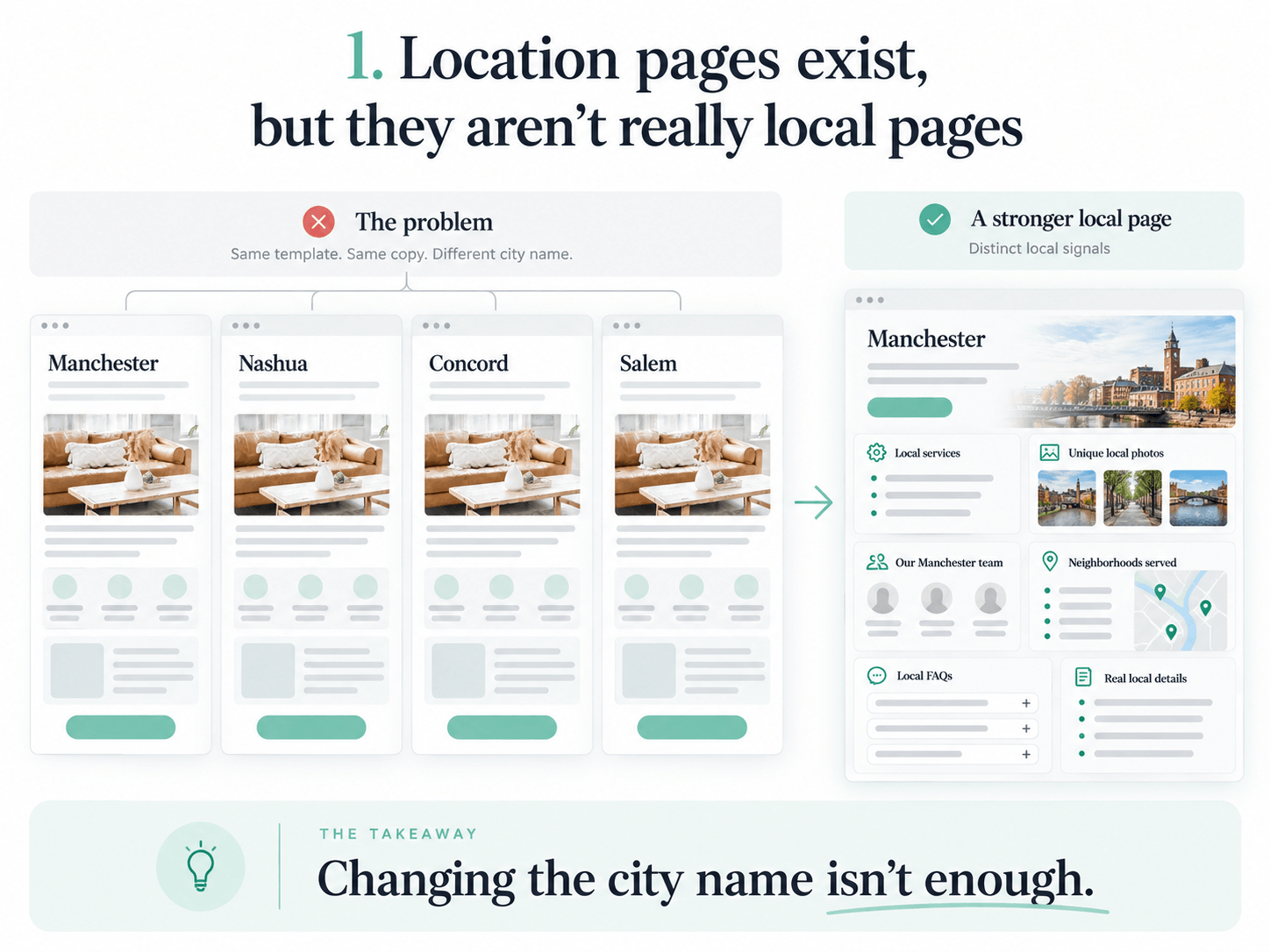
When we evaluate location pages, we look at things like:
- Whether the page contains meaningful market-specific information
- How the location connects to relevant service content
- Whether search engines can clearly understand the geographic area it serves
- Whether important local information is rendered directly on the page
- Whether the page is supported by internal links and other sitewide signals
The question isn’t just whether every franchise location has a URL.
It’s whether every location has a page that search engines can understand as a distinct local entity.
2. The location finder is doing too much of the work
Location finders are great for users.
They are not always great website architecture.
We regularly see franchise websites where the entire local experience starts with a ZIP code search. From a UX perspective, that makes perfect sense. From an SEO perspective, we immediately want to know what happens when that search box isn’t there.
Can a crawler discover every location page naturally? Is there a crawlable location directory? Are states, cities, markets, and locations connected through normal internal links?
Or are hundreds of important URLs effectively sitting behind a search experience?
A page can be technically indexable and still be poorly integrated into the website.
That’s the distinction that matters.
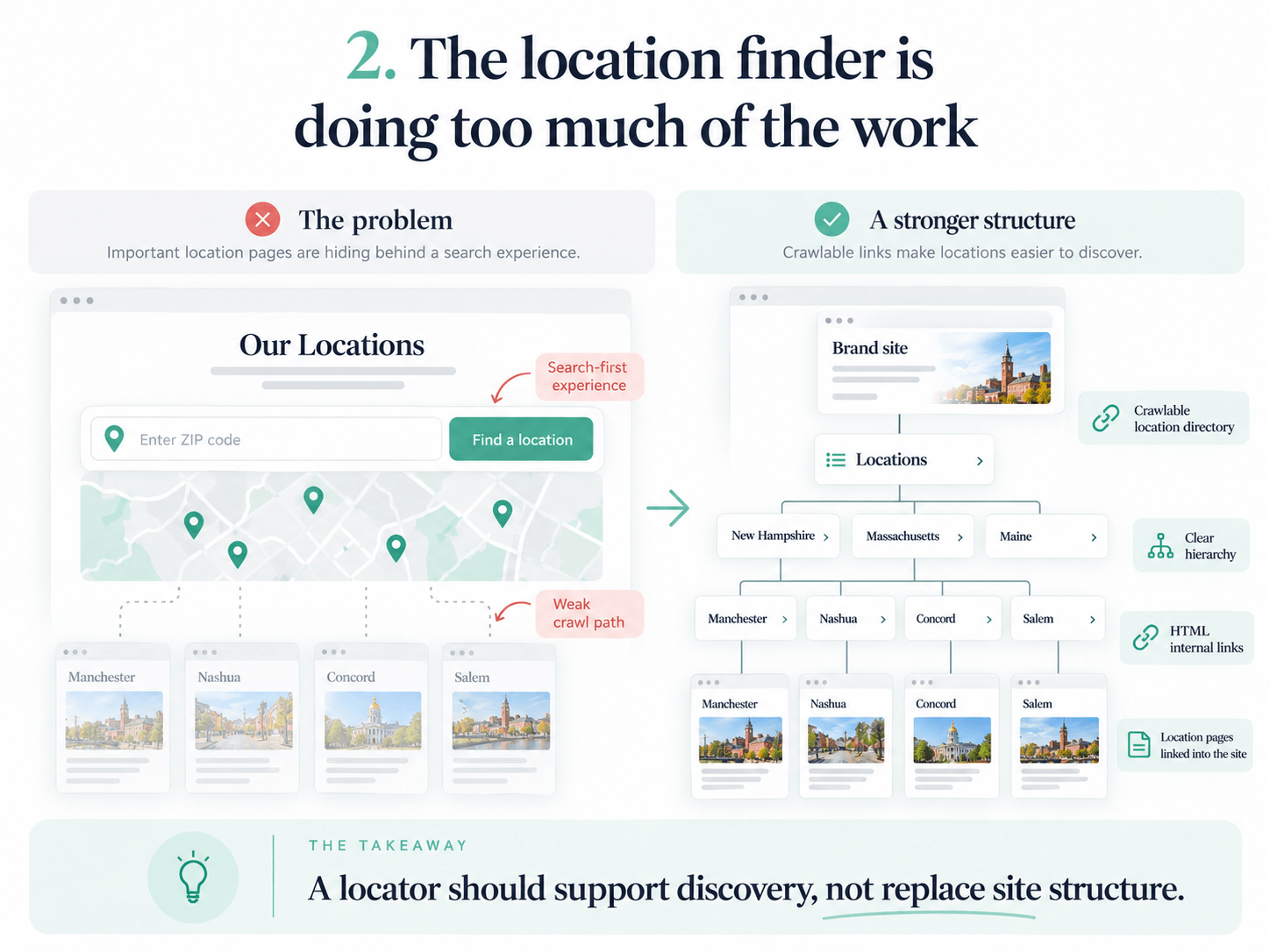
Internal linking helps search engines understand hierarchy, importance, and relationships. On a franchise website, that might mean connecting:
- Brand to service
- Service to market
- Market to location
- Location back to relevant local services
There isn’t one universally correct structure, but there does need to be a structure.
3. Canonicals, redirects, and indexation rules are fighting the site
This is one of those problems that tends to hide until something goes wrong.
Franchise websites often evolve through redesigns, CMS migrations, new location launches, closures, URL changes, and multiple agencies or development teams.
Over time, the technical rules start piling up.
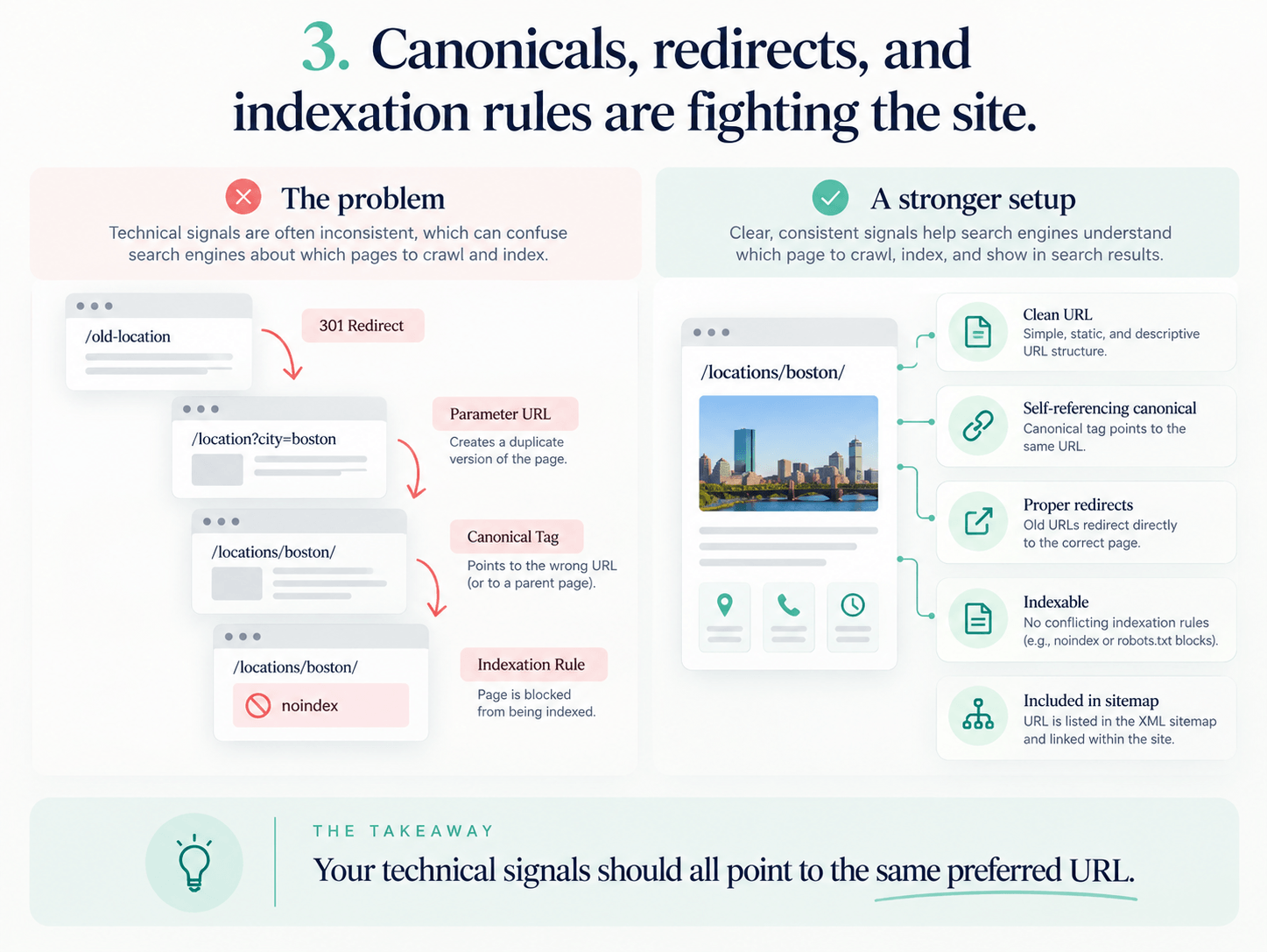
We commonly find issues like:
- Redirect chains
- Old location URLs remaining indexed
- New pages canonicalizing somewhere unexpected
- XML sitemaps containing URLs that shouldn’t be indexed
- Important pages inheriting
noindexrules - Parameter URLs creating duplicate versions of the same content
The real danger is scale.
One incorrect canonical on a small website affects one page.
One incorrect template rule on a franchise website can affect hundreds.
That’s why we look for patterns, not just isolated errors. If ten location pages are behaving strangely, the bigger question is whether those ten pages are exposing a problem with the template powering all of them.
4. Structured data doesn’t reflect the actual business structure
Schema is another area where franchise sites often look simpler than they really are.
You don’t just have a website.
You have a corporate organization, individual locations, services, products, breadcrumbs, articles, and potentially other entities that all need to make sense together.
Too often we see one of two extremes: barely any structured data, or structured data added everywhere without much thought about how the entities connect.
The goal isn’t to see how many schema types we can fit onto a page.
The goal is to make the business easier for machines to understand.
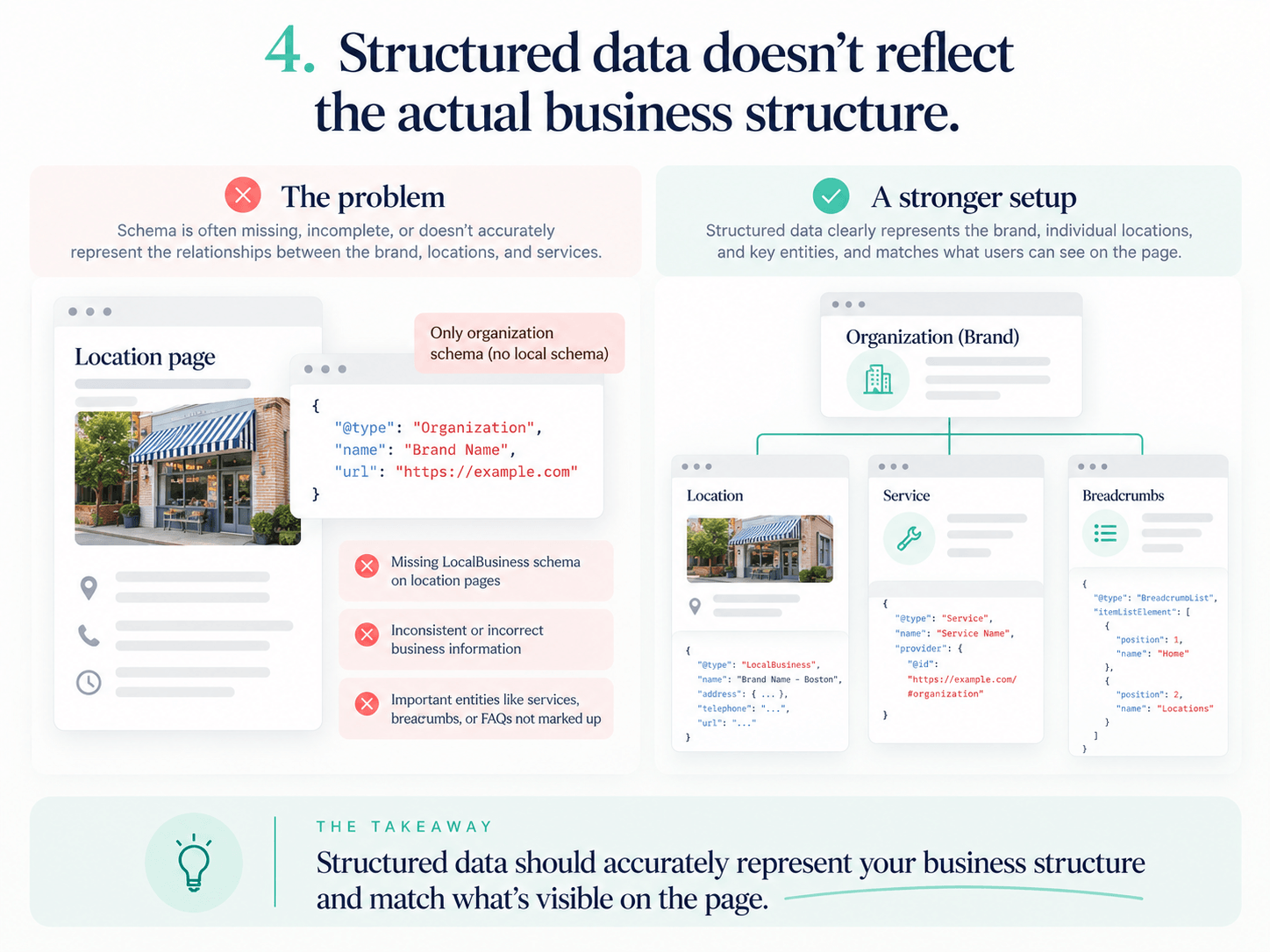
For a franchise site, we look at questions like:
- Is the corporate organization clearly identified?
- Are individual locations represented correctly?
- Are names, addresses, phone numbers, URLs, and other identifiers consistent?
- Do breadcrumbs reinforce the site hierarchy?
- Does the structured data match what users can actually see on the page?
- Are important relationships between the brand, locations, and services clear?
Structured data won’t rescue weak pages or broken architecture, but it can reinforce a strong foundation.
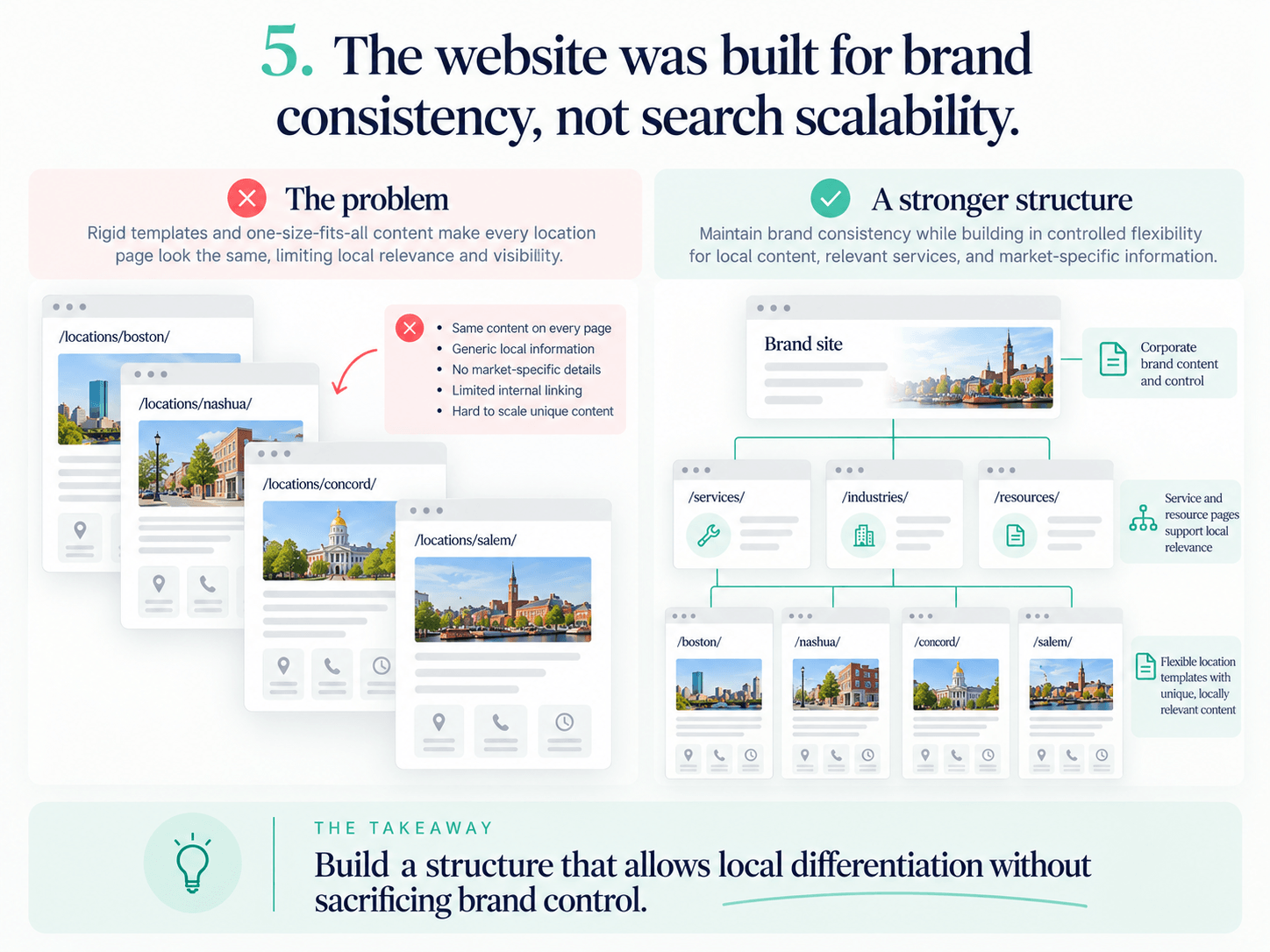
5. The website was built for brand consistency, not search scalability
This may be the biggest franchise SEO problem because it isn’t really one technical error.
It’s an architectural philosophy.
Franchise websites are understandably designed around consistency. Corporate needs control over branding. Legal teams need approved language. Operations teams want information to stay accurate.
All reasonable.
The problem comes when consistency turns into rigidity.
Every location uses the same content. Every market gets the same FAQs. Every service page is national. Every local update requires a development ticket. Every page type is locked into one template.
At that point, the system keeping the brand organized can also become the system limiting its organic growth.
The answer isn’t giving franchisees unlimited control.
It’s building controlled flexibility into the platform through things like:
- Structured fields for local information
- Market-specific content modules
- Reusable local components
- Clear separation between corporate-controlled and locally editable content
- Templates that maintain brand standards without making every page identical
That’s what allows local visibility to scale without sacrificing brand control.
A quick franchise SEO checklist
If you’re evaluating your own franchise website, start here:
- Can search engines discover every location without relying on the location finder?
- Does each location have enough unique information to represent a real local business?
- Are location, market, service, and corporate pages connected through clear internal linking?
- Are canonicals, redirects, sitemaps, and indexation rules sending consistent signals?
- Does your structured data accurately represent both the brand and individual locations?
- Can the website support local differentiation without sacrificing corporate control?
- Are technical problems isolated, or are they being generated by templates at scale?
That won’t replace a full technical audit.
But it will tell you where to start looking.
Franchise SEO problems compound quickly
One weak location page probably isn’t going to derail an entire franchise SEO program.
The challenge is when the same weakness exists across every location.
A thin template becomes 400 thin pages. A poor internal linking decision isolates 400 locations. A schema mistake gets deployed 400 times.
That’s why franchise SEO requires a different mindset.
You aren’t optimizing pages one at a time.
You’re engineering a system that has to work at scale.