
What Home Service Businesses Need to Know about GBP
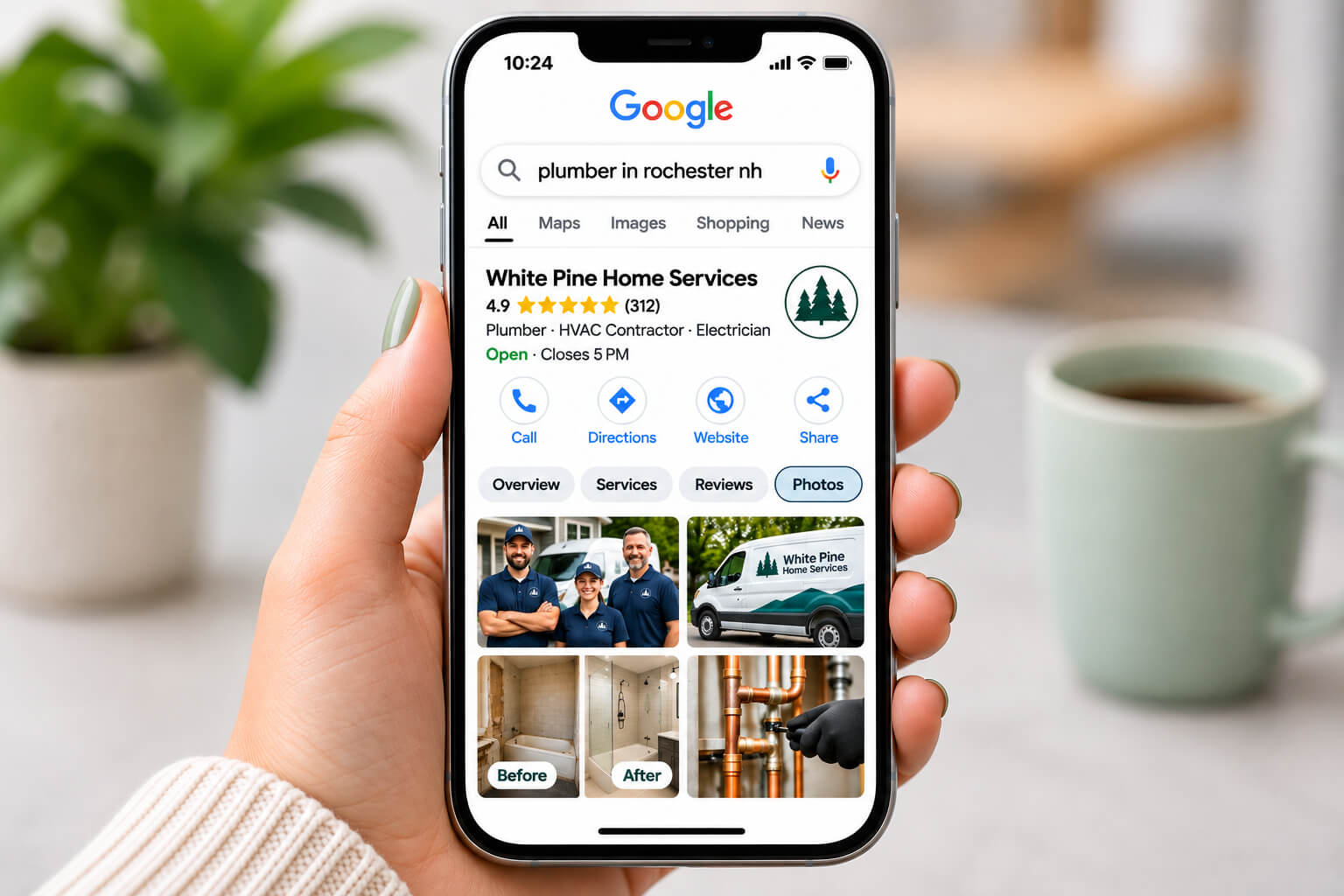
- Your GBP is often the first thing a homeowner sees when they search for a plumber, electrician, or roofer, and most of them never scroll past the local pack
- Home service businesses have unique GBP needs: service area setup, before-and-after project photos, emergency service visibility, and trade-specific categories
- The fundamentals (complete profile, consistent info, active reviews) still apply. For the full breakdown, see our GBP Optimization Guide. This article covers what’s different when you’re in the trades
- Whether you’re a one-truck operation or managing 50 locations across a region, GBP is the foundation of local visibility
Why GBP Hits Different for Home Services
When a homeowner’s water heater dies at 9 PM, they’re not browsing websites. They’re Googling “emergency plumber near me” and calling whoever shows up first in the local pack.
That’s your Google Business Profile. And for home service businesses, it carries even more weight than it does for most industries, because the buying decision happens fast, the trust bar is high (you’re entering someone’s home), and the search is almost always local.
Google Business Profile signals account for 32% of local pack ranking factors, the single largest category. For home service businesses competing in a defined service area, getting this right isn’t optional.
If you’re new to marketing your home service business online, our home service marketing guide covers the full picture, from websites to SEO to paid media. GBP is one piece of that puzzle, but it’s the piece most businesses either skip or set up once and forget.
Pick the Right Categories (and Be Specific)
Your primary category is the single most important field on your profile. It determines which searches you show up for and which features Google unlocks for you.
Be as specific as your trade allows. “Plumber” is better than “Contractor.” “Roofing Contractor” is better than “Home Improvement.” If you specialize in a niche, like solar panel installation or foundation repair, there’s likely a category for it.
Add secondary categories for related services you actually offer. An HVAC company might add “Air Conditioning Contractor” and “Heating Contractor” alongside their primary. A plumber who also does bathroom remodels could add “Bathroom Remodeler” as a secondary.
Don’t pad with categories you can’t back up. Google notices when your categories say one thing and your reviews say another.
For multi-location brands: Each location should have its own profile with its own primary category. If your franchise covers multiple trades (like a general handyman service), the primary category should reflect what that specific location does most. A location that handles 80% plumbing calls should lead with “Plumber,” not “Handyman.”
Service Area Setup (Most Home Service Businesses Get This Wrong)
Most home service businesses are service area businesses (SABs), meaning you go to the customer rather than the other way around. GBP handles this differently than a storefront.
Set your service area by the cities, zip codes, or radius you actually cover. Don’t list every city in the state hoping for visibility. Google rewards accuracy, and a customer 90 miles away isn’t a good lead anyway.
If you have a physical office but don’t serve walk-in customers, you can list your address and still define a service area. If you work from home, hide the address and use the service area feature only.
For multi-location brands: Each location needs its own profile with its own defined service area. Overlap is fine if two locations genuinely cover the same area, but avoid creating duplicate listings for the same address. Franchise systems should have a clear territory map that translates directly into each location’s GBP service area settings.
List Your Services Like a Menu
The Services section is underused by most home service businesses, and it’s one of the easiest ways to show up for specific searches.
Don’t just list “plumbing.” Break it down into what people actually search for:
- Emergency drain cleaning
- Water heater installation and repair
- Slab leak detection
- Gas line repair
- Sewer camera inspection
- Bathroom remodeling
Each service entry lets you add a description. Use that space to explain what the service includes and who it’s for. Think like the homeowner searching at midnight, not like someone writing a trade manual.
Add seasonal services when they’re relevant. Furnace tune-ups in fall, AC maintenance in spring, gutter cleaning before winter. Update these throughout the year so your profile reflects what you’re actually doing right now.
For multi-location brands: Build a master service list at the brand level, then let each location customize based on what they actually offer. A franchise location in Arizona probably doesn’t need “snow removal” on their profile, even if the brand offers it elsewhere.
Photos That Win Jobs
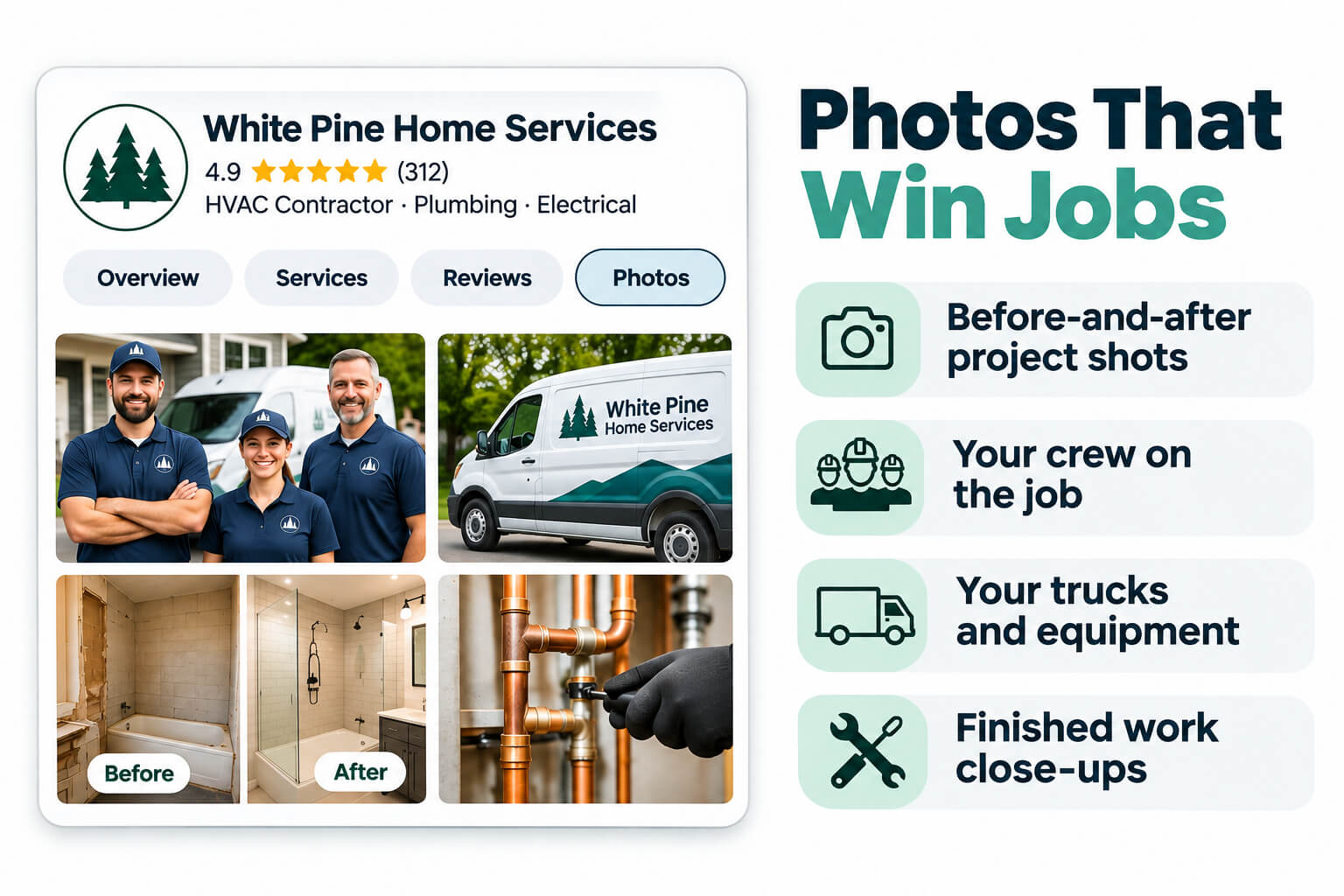
For home service businesses, photos aren’t decoration. They’re proof. Homeowners are deciding whether to let a stranger into their house, and your photos are doing a lot of that convincing.
What works:
- Before-and-after project shots. These are your most powerful asset. A crumbling bathroom next to the finished tile job tells a better story than any description.
- Your crew on the job. Real people, in your branded gear, doing real work. This builds trust faster than a stock photo of a handshake.
- Your trucks and equipment. Branded vehicles signal professionalism. Clean, organized equipment signals competence.
- Finished work close-ups. Clean solder joints, straight tile lines, a perfectly graded yard. The details that another tradesperson would notice are the same ones homeowners use to judge quality.
Upload new photos regularly. Three to five per month keeps your profile active and signals to Google that you’re a real, operating business.
For multi-location brands: Create a photo standard (branding visible, good lighting, consistent quality) but let each location upload their own project work. Corporate stock photos across 30 locations all looking identical doesn’t build local trust. A branded photo library with guidelines and templates helps franchisees post consistently without a photographer on staff.
Reviews Are Your Reputation (Manage Them Like It)
74% of consumers only consider reviews from the last three months, and 47% won’t contact a business with fewer than 20 reviews. For home service businesses, where a single job can be worth thousands of dollars, reviews are doing heavy lifting.
When to ask: Right after the job wraps, while the homeowner is looking at their new kitchen or finally has hot water again. That’s peak satisfaction. Send a follow-up text or email within 24 hours with a direct link to your Google review page.
What to say when you respond: Thank them, mention the specific work (“glad the new water heater is running smoothly”), and keep it short. For negative reviews, acknowledge the issue, skip the defensiveness, and offer to make it right offline. Future customers are reading your response more carefully than the complaint itself.
For multi-location brands: Review volume and response quality should be tracked across every location. Build a response playbook so franchisees or local managers can reply quickly and consistently without needing approval for every review. Set a target for minimum monthly review count per location and make it part of your operational metrics. A location with three reviews from 2024 is invisible next to a competitor with 50 from this quarter. For a deeper look at how franchise brands should approach local visibility across locations, see our guide to marketing for home service franchises.
Posts That Actually Get Seen
GBP posts expire after about seven days, so treat them like a rotating billboard. For home service businesses, the best posts are timely and seasonal.
Post ideas by season:
- Spring: AC tune-up specials, deck and patio season, roof inspections after winter
- Summer: Landscaping promotions, outdoor lighting, energy efficiency tips
- Fall: Furnace maintenance, gutter cleaning, winterization checklists
- Winter: Emergency service availability, pipe freeze prevention, holiday hours
Always include a call to action. “Book now,” “Call for a free estimate,” or “Schedule your inspection” give people a clear next step.
For multi-location brands: Create a content calendar at the corporate level with templated posts that locations can customize. Monthly post packages with pre-written copy and brand-approved photos keep profiles active without expecting every franchisee to become a content creator.
Attributes and Features for Home Services
GBP attributes vary by your specific primary category. What’s available for a plumber won’t be identical to what shows up for a landscaper or a pest control company.
Log into your profile and check what’s actually available. Common attributes across home service categories include:
- Online estimates (if your category surfaces it)
- Online appointments or booking links
- Wheelchair accessible (if you have a physical office)
- Women-owned, veteran-owned, or other identity attributes
Don’t assume features you’ve seen on other profiles will show up on yours. The only way to know what’s available for your category is to look. Fill out everything that’s accurate, because these show up as search filters, and an empty field means you’re invisible in filtered results.
For multi-location brands: Audit attributes by location, not just by brand. Even within the same franchise, different locations may have different categories and different available attributes. A quarterly attribute check across all locations catches gaps before they cost you visibility.
Keep It Current (The Part Everyone Skips)
A GBP profile isn’t a set-it-and-forget-it asset. Treat it like the front door of your business, because for most customers searching online, it literally is.
Monthly check: Hours accurate? Services reflect what you’re doing this season? Recent photos uploaded? Reviews responded to? Posts from the last week or two?
For multi-location brands: Build a GBP audit into your regular operational reviews. If you’re doing quarterly site visits or franchise check-ins, add a five-minute GBP review to the agenda. The locations that stay on top of their profiles are consistently the ones that show up in the local pack.
For the full breakdown of GBP fundamentals that apply to every business, read our GBP Optimization Guide. And if keeping up with all of this sounds like one more thing on an already full plate, we work with local home service businesses and home service franchises to keep this stuff running so you can focus on the actual work.