


Bottom Line Up Front: Query Fan-Out and Content Strategy
Query fan-out is how search engines and AI systems break a broad question into smaller sub-questions and look for content that answers each one. It’s not a new content strategy — it’s a mechanism that makes the strategy we’ve always recommended more important than ever.
- Query fan-out is already shaping how Google’s AI Overviews and AI tools like ChatGPT assemble answers from multiple sources
- Keyword research is still a valuable tool for finding trends, gauging demand, and tracking competitors, but it was never the whole picture
- Content that covers the real angles of a topic — the sub-questions your audience actually has — is what catches fan-out queries
- This affects both how you build content clusters and how you structure individual articles
- None of this is new in principle. Writing useful, comprehensive content for real people has always been the strategy that survives algorithm changes, model shifts, and whatever comes next.
If you read our post on pillar content strategy, you saw us mention query fan-out a couple of times. We talked about how Google decomposes broad queries into sub-questions, and how your supporting content is what answers them. But we didn’t go deep on the mechanics, and the mechanics matter.
Query fan-out isn’t a content strategy. It’s not a framework you adopt or a checklist you follow. It’s a mechanism — a way of understanding what happens between someone typing a question and the answer they get back. And once you understand it, a lot of things about content strategy that might have felt like best-practice hand-waving suddenly have a very concrete explanation behind them.
What Is Query Fan-Out?
The concept is simpler than the name makes it sound. When someone types a broad or complex query into Google (or asks ChatGPT, or Perplexity, or any AI-powered search tool), the system doesn’t just look for one page that matches those exact words. It breaks the query apart into smaller, more specific sub-questions, finds content that answers each one, and assembles a response from multiple sources.
Think about someone searching “is solar worth it for my house.” That’s not really one question. It’s a bundle of questions wrapped in a single search: What does solar cost? How much will I save on electricity? What tax incentives are available? Does my roof orientation matter? How long do panels last? What about battery storage?
Google’s AI Overviews are doing this visibly now. You can see the response pulling from different sources for different parts of the answer. But the principle has been baked into search for a while — related searches, People Also Ask boxes, and the way Google has gotten better at understanding intent over time are all earlier versions of the same idea. What’s changed is how explicitly and aggressively the systems are now decomposing queries and sourcing answers to each piece.

How Fan-Out Shows Up in Practice
Let’s walk through a real example. Say someone searches “best CRM for small business.”
A traditional keyword-focused approach would say: target that exact phrase, write a listicle, try to rank. And that’s not wrong — there’s volume there and it’s a valid piece of content to have.
But fan-out means Google is also generating and answering sub-questions behind the scenes. Things like: What features should a small business CRM have? How much does a CRM cost? Is HubSpot free CRM actually free? What’s the difference between a CRM and a spreadsheet? Do I even need a CRM if I only have 20 clients?
Each of those sub-questions is a potential source pull. If your site has content that answers one of them well, you might show up in the AI Overview for the original broad query even if you don’t rank for “best CRM for small business” at all. Your supporting content — the angle-specific, question-specific pieces — is what catches those sub-queries.
Now flip it. If all you have is the one listicle and nothing else, you’re competing for the broad term with no supporting depth. The AI Overview pulls from sites that cover the sub-questions. You’ve got one page. They’ve got a cluster. You’re not in the conversation.
This Isn’t Actually New
Here’s the thing that gets lost in all the “AI is changing everything” noise: writing content that covers the real angles of a topic, that anticipates follow-up questions, that actually helps the person reading it — that has always been good content strategy. Always.
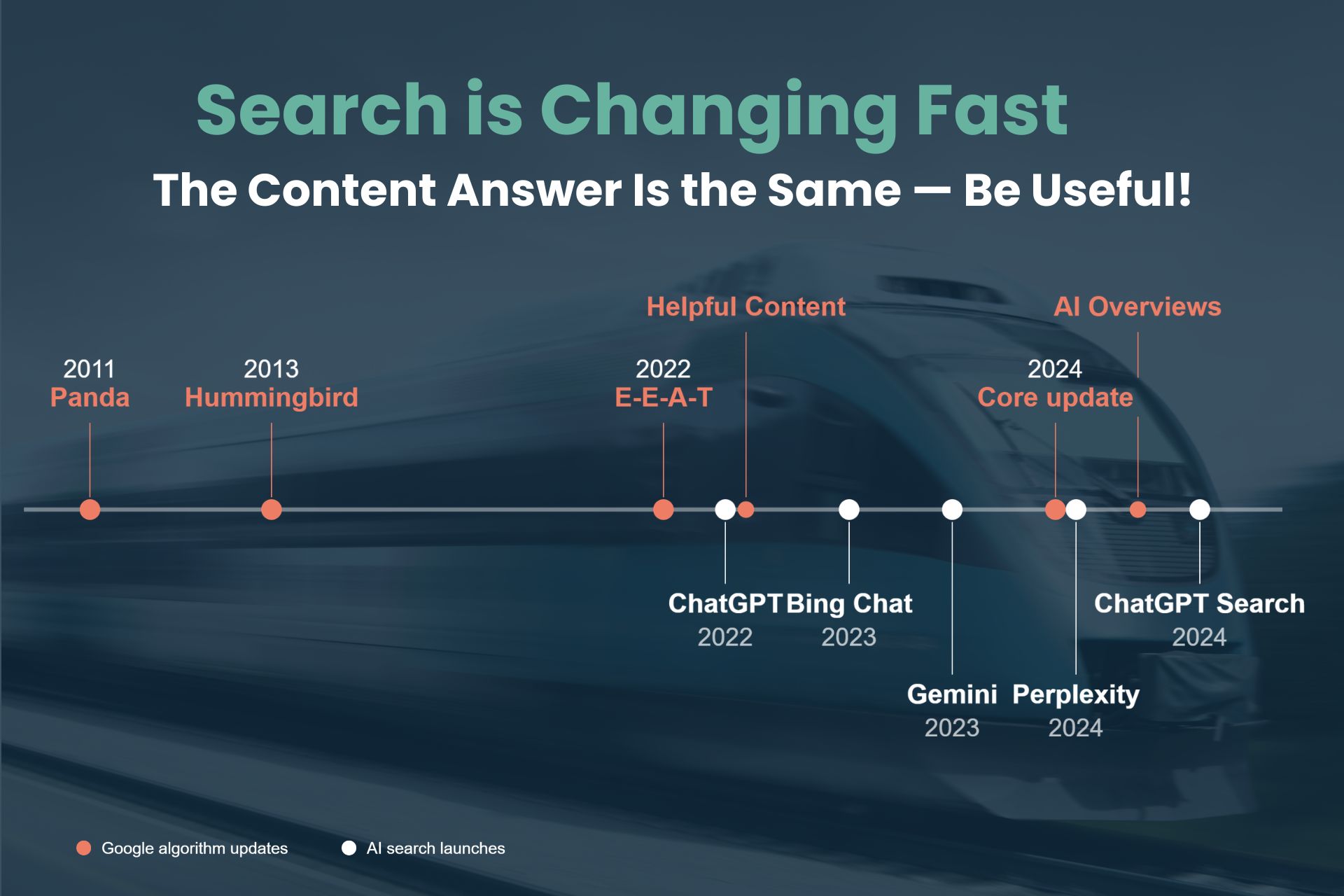
Every major algorithm update Google has rolled out over the past decade has landed in the same place. Panda penalized thin content. Hummingbird rewarded semantic understanding. Helpful Content Update went after content written for search engines instead of people. E-E-A-T raised the bar on expertise and experience. And now AI Overviews and query fan-out are rewarding topical depth and comprehensive coverage.
The through line is the same every time: content that genuinely serves real people survives. Content that tries to game a system works until the system changes, and the system always changes.
Good writers have always thought this way. When you sit down to write a genuinely useful guide about something, you naturally think about the sub-questions. You think about what someone would ask next. You think about the objections, the edge cases, the “but what about” follow-ups. That’s not a new SEO tactic — that’s just good writing.
Fan-out doesn’t change the strategy. It makes the mechanics of why that strategy works more visible. The systems are finally catching up to what thoughtful content creators have been doing all along.
Keyword Research Isn’t Dead (But It’s Not the Whole Picture)
Every few years, someone publishes a post declaring keyword research dead, and every few years they’re wrong. Keyword research is still a critical part of our toolset. We use it constantly. It’s how we identify trends, gauge topic demand, see where competitors are gaining or losing visibility, and prioritize where to invest content resources. When a client is deciding which pillar to build first or which topics have real search demand behind them, keyword data is a big part of that conversation.
But here’s what keyword research has never been great at: telling you what to write about for the people who aren’t searching yet. Or who are searching in ways that don’t register in the tools. Or who are asking an AI assistant instead of typing into Google. Or who have a question so specific that it’ll never accumulate enough search volume for Semrush to track it.
The real content strategy question isn’t “what keywords should we target?” It’s “what does our audience need from us?”
If you’re a B2B software company, your audience includes people evaluating your product, people comparing you to competitors, people trying to solve a problem they don’t know you solve yet, and existing customers who need help getting more value from what they already bought. Those are different audiences with different questions, and you need content that speaks to all of them. Some of those questions will show up in keyword research. Some won’t. Both matter.
We’ve never been targeting a keyword or a search query, not really. We’ve always been trying to be useful and helpful to customers and potential customers. The keyword was just the proxy — the measurable thing that pointed us toward what people wanted to know. Fan-out is a reminder that the proxy was never the point. The point was always being the answer.
How Fan-Out Changes Content Structure
This is where it gets practical. Fan-out doesn’t just affect your content calendar — it affects how you structure individual pieces of content and how those pieces connect to each other.
At the cluster level, fan-out reinforces why pillar content strategy works. A pillar page covers the broad topic. Supporting content covers the angles — the sub-questions that a broad query generates. When Google decomposes a query, your cluster is what provides the answers. Each supporting piece is a potential source pull for a different sub-question. The more angles you cover with real depth, the more surface area you have across fan-out queries.
At the article level, fan-out changes how you think about structure within a single piece. Your headers and sections should map to the sub-questions someone might ask about your topic. Not because you’re optimizing for headers (that’s old-school SEO thinking) but because a well-structured article that covers the real angles of a topic naturally aligns with how fan-out decomposes queries.
Think about it practically. If you’re writing an article about commercial HVAC maintenance, the sub-questions might include: How often does commercial HVAC need maintenance? What does a maintenance visit include? What’s the cost? What happens if I skip it? What’s the difference between preventive and reactive maintenance? What should I look for in a service contract?
An article structured around those real questions — with sections that genuinely answer each one — is an article that’s positioned to catch fan-out queries. Not because you reverse-engineered Google’s algorithm, but because you wrote something comprehensive and useful.
Here’s a simple comparison of how these two approaches play out:
| Keyword-First Approach | Audience-First Approach | |
|---|---|---|
| Starting point | “commercial HVAC maintenance” has 720 monthly searches | Our customers ask us about maintenance every week |
| Content plan | One article targeting the primary keyword | One pillar article plus supporting pieces on cost, frequency, contracts, and seasonal timing |
| Article structure | Sections built around keyword variations | Sections built around the questions customers actually ask |
| Fan-out coverage | Limited to what one page can rank for | Multiple pieces catching sub-queries across the topic |
| Long-term value | Vulnerable to ranking shifts on one term | Resilient because value comes from depth, not one position |
The audience-first approach doesn’t ignore keyword data. It uses it. But it starts with the customer, not the spreadsheet.
Structuring Content to Be the Answer
Let’s tie this together. Query fan-out is a mechanism, not a strategy. But understanding the mechanism clarifies why certain strategies work and others don’t.
The content that performs in a fan-out world is the content that was written to be genuinely useful in the first place. Content that covers real angles. Content that anticipates the next question. Content that’s structured so both humans and systems can find the specific answer they need within it.
This isn’t about gaming a system. It never has been, and every time someone tries, the system eventually catches up and penalizes it. The game has always been: understand your audience, know what they need, and build content that delivers it. Structure that content so it’s findable, navigable, and connected. And keep doing it over time.
Fan-out just raises the stakes on structure and depth. The sites that treat content as an architecture — pillars, clusters, intentional internal links, comprehensive topic coverage — are the ones positioned to show up when a broad query gets decomposed into a dozen sub-questions. The sites that publish isolated posts with no structural home are the ones that won’t.
Your content should be the answer your customers are looking for. Fan-out is just the latest reason to make sure it’s structured so they can actually find it.
Want help building a content strategy that’s ready for how search actually works now? Let’s talk about it.
Questions about Query Fan-Out & Content
Is query fan-out the same as People Also Ask?
Related, but not exactly the same. People Also Ask is a visible feature in search results that shows related questions. Query fan-out is the broader mechanism happening behind the scenes where search engines and AI systems break a query into sub-components to source answers. PAA is one surface where fan-out shows up, but fan-out also drives how AI Overviews pull from multiple sources and how AI tools like ChatGPT decompose questions before searching.
Does query fan-out mean I need to change my content strategy?
Probably not as much as you think. If you’re already writing useful, comprehensive content for your actual audience and organizing it into topic clusters, you’re already doing most of what fan-out rewards. The main shift is being more intentional about covering angles and sub-questions within your content, both at the article level and across your cluster.
Should I stop using keyword research because of fan-out?
No. Keyword research is still valuable for identifying demand, spotting trends, and understanding where competitors are gaining visibility. Fan-out doesn’t make keyword data irrelevant — it just means keyword data isn’t the only input for content planning. Pair it with a real understanding of what your audience needs, and you’ll cover both the queries that show up in the tools and the ones that don’t.
How do I know if my content is catching fan-out queries?
Look at your Google Search Console data for long-tail impressions and clicks — queries you didn’t specifically target but are showing up for. If you’re seeing impressions for conversational or multi-part queries related to your content topics, that’s fan-out at work. Also check whether your pages are appearing in AI Overviews for broader terms in your space.