


Bottom Line Up Front: Pillar Content Strategy
If your blog is a chronological list of posts with no real structure behind it, you’re splitting your authority instead of building it. A pillar content strategy organizes your content into clusters that actually work together.
- Flat blog structures hurt your users, your SEO visibility, and your chances of showing up in AI-generated results
- Pillar pages act as the hub for each core topic, with supporting content feeding authority back up instead of floating on its own
- Search volume matters for choosing pillars, but it’s not the only filter for supporting content. If a topic serves your audience and strengthens your cluster, it earns its place.
- Google’s AI Overviews and query fan-out are making topical depth and content structure more important than ever
- Building clusters isn’t complicated, but it does require thinking about your content as an architecture, not just a publishing calendar
I’ve lost count of how many times I’ve audited a website and found the same thing: hundreds of pages all sitting at the same level with no structure connecting them and traffic that’s either flat or declining. Blog posts carrying the same structural weight as core service pages. An obscure product accessory page ranking with the same authority signal as the flagship product line. A “careers” page and a “why choose us” page and a three-year-old holiday blog post all treated as equals in the eyes of the site architecture.
The content isn’t always bad. Some of it is genuinely good. But it’s buried in a structure that’s working against it.
This is the flat structure problem, and it shows up everywhere. Flat blogs where every post publishes to /blog/ in reverse chronological order with no hierarchy. Flat service sites where every page sits one click from the homepage with no signal about what matters most. E-commerce sites where accessories and add-ons sit at the same level as your core product categories. It’s not limited to one page type or one industry. It’s a structural issue, and it affects everything downstream.
The fix isn’t publishing more. It’s building smarter. That’s where pillar content strategy comes in.
Your Flat Structure Is Working Against You
When I talk about this with clients, I break it into three audiences because a flat structure doesn’t just create one problem. It creates a different problem for every entity trying to use your site.
Bad for Your Audience
Think about the last time you landed on a blog post from a Google search. You read it, maybe found it helpful, and then what? If the site didn’t give you a clear next step, you probably bounced. That’s what a flat structure does to every visitor.
There’s no guided path from what someone is reading to what they need next. Every page looks equally important, which really means nothing looks important. Your visitors end up relying on site search (if you even have one) or just leaving. The site should be doing that work for them, guiding them from a supporting piece to the deeper resource, from a blog post to a service page, from a question to an answer. A flat structure doesn’t do any of that.
Bad for SEO Visibility
This is the one that usually gets people’s attention. When every page on your site sits at the same level, your authority splits across all of them instead of stacking behind the pages that actually matter.
Let’s say you’re a home services company with 200 blog posts covering everything from “how to unclog a drain” to “best holiday lighting ideas.” Every single one of those posts carries the same structural weight. Google can’t tell if you’re a plumbing company, an electrician, or a lifestyle blog. There’s no hierarchy telling search engines what your site is really about, which pages should rank for your most important terms, or how your content relates to itself. You’re also burning crawl budget on pages that aren’t doing any strategic work while the pages you actually need to rank never get the authority they deserve.
Bad for AI Visibility
This is the newer piece of the puzzle, and it’s only getting more important. AI systems (Google’s AI Overviews, ChatGPT, Perplexity, all of them) are looking for authoritative sources on specific topics. When your content is scattered across a flat structure with no clear relationships between pieces, AI can’t identify one go-to source on your site for any given topic. So it cites none of it.
No structure means no legible relationships between your content for AI to read. Even if you’ve written thoroughly about a subject across ten different posts, without the connective tissue between them, it looks like shallow, scattered coverage instead of real topical depth. AI needs to see that your site has a clear point of view and a body of organized expertise, not just a collection of loosely related articles.

The Fix: Pillars, Not Piles
The concept is straightforward even if the name sounds like marketing jargon. Instead of dumping every piece of content into one flat blog, you organize it around pillar pages with clusters of supporting content underneath.
A pillar page is the comprehensive resource for a core topic or service area. These are the pages you want ranking. They’re the ones that say “this is what we do and we go deep.” For a digital marketing agency, your pillars might be SEO, web design, and content strategy. For a dental practice, maybe it’s cosmetic dentistry, implants, and pediatric care. For a law firm, it could be personal injury, workers’ comp, and wrongful death. Your pillars map to the things you actually want your audience coming to you for.
Blog content clusters sit underneath each pillar, organized by the pillar they support. Each post links back to its pillar page, feeding authority upward instead of sitting orphaned in a reverse-chronological feed. A post about “how often to update your Google Business Profile” isn’t just a blog post. It’s a supporting piece in our local SEO cluster, and it links back to our local SEO pillar, and that pillar gets stronger because of it.
Location pages connect to service pillars rather than floating independently. They show local authority and availability, but their job is to reinforce the pillar, not compete with it. “Dental implants in [city]” should funnel authority to your implants pillar, not exist as an island.
Multilingual content mirrors the same pillar structure. If you’re building version of your site in a different language, it should be a true parallel architecture (a /es/ structure for Spanish for example, that mirrors your English pillars), not a handful of disconnected translated pages floating in the void.
The result is that search engines and users both land on the right page first. Your pillar carries the weight. Your cluster supports it. Everything has a job and everything is connected.
How to Build a Content Cluster in 4 Steps
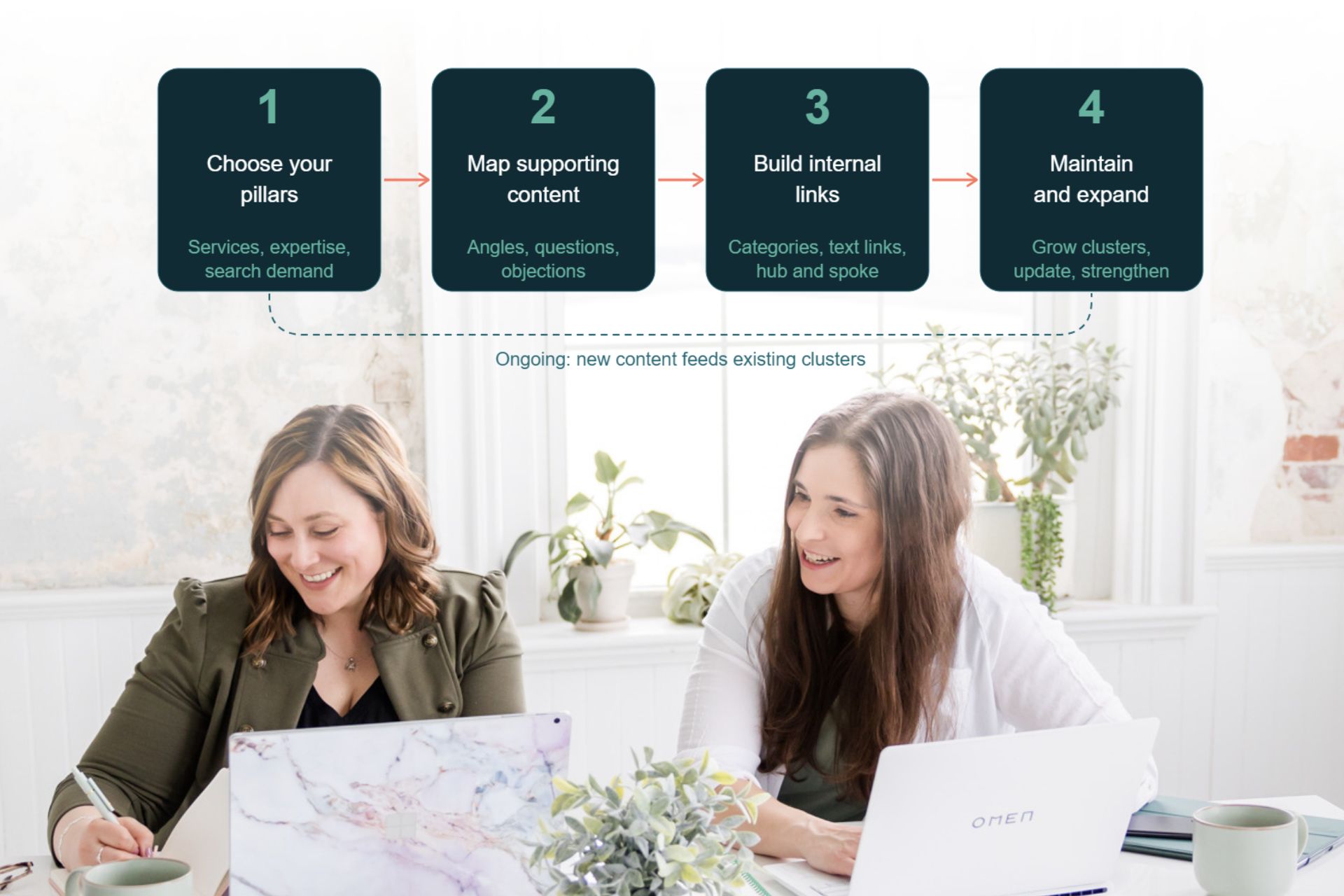
1. Choose Your Pillars
Start with what you know. What are your primary services or products? What’s your true area of expertise? This isn’t a brainstorming exercise, it’s a focus exercise. Keep it tight around the things you really want your audience coming to you for.
Once you’ve identified your core pillars, factor in search volume to prioritize and refine. If you have four potential pillar topics and two of them have significantly more search demand, that tells you where to invest your energy first. This is also where competitive research comes in. We look at what your direct competitors are ranking for and where they’ve built depth, but this isn’t about copying what they published. It’s about understanding the landscape so you can differentiate. Your content strategy should reflect what makes you different from your competition, not mirror it.
At Trebletree, our pillars map to our services (SEO, web design, content) and to the types of clients we serve (franchise brands, cooperatives, local businesses). Those client-type pillars exist because our audiences have different needs and different entry points. A franchise marketing director and a local plumber are not searching for the same things, and they shouldn’t land on the same content.
2. Map Your Supporting Content by Angles, Not Just Keywords
This is where the real strategic thinking happens. For each pillar, ask yourself what your audience actually needs to understand around this topic. What questions do they have? What objections come up in sales calls? What adjacent topics help someone make a decision?
Supporting content should cover the angles of a topic, not just target a list of keywords. A dental practice with an implants pillar might need supporting posts about cost comparisons, the procedure timeline, aftercare, insurance coverage questions, and “am I a candidate” content. Those aren’t all high-volume keywords. Some of them might not show up in Semrush at all. But they’re the questions real patients ask, and covering them builds the kind of topical depth that search engines and AI systems reward.
Think about it from a user perspective: if someone lands on your pillar page and then needs more detail on a specific angle, does that content exist on your site? If not, they’re leaving to find it somewhere else, and they’re taking that engagement signal with them.
3. Build Your Internal Linking Architecture
This is where the cluster actually becomes a cluster and not just a collection of posts about similar topics. Internal linking is the connective tissue that tells search engines (and users) how your content relates to itself.
The hub and spoke model is the foundation. Every supporting piece links to its pillar. The pillar links out to its supporting content. But there’s more to it than just dropping links into body copy.
For blogs, categories make this easy and most sites underuse them. Your blog categories should map to your pillars. When they do, you can put a filtered blog listing on your pillar page that dynamically shows all the supporting content in that cluster. Visitors can browse related content without leaving the pillar ecosystem, and you’ve created a structural relationship that search engines can read.
Then there are the contextual text links within each post, linking to the pillar, to other relevant supporting pieces, and where appropriate, to supporting content in adjacent clusters. These aren’t decorative. They’re architectural. Every internal link is a signal about what’s related and what matters.
One thing to keep in mind: content can support more than one pillar. This article you’re reading right now supports both our content strategy pillar and our SEO pillar because the topic sits at the intersection of both. That’s fine. Content doesn’t have to live in one rigid silo. What matters is that the linking structure makes those relationships clear.
4. Maintain and Expand the Cluster Over Time
A content cluster isn’t a one-time project. It’s an ongoing structure that grows with your business. As you publish new content, it should have a home in an existing cluster (or signal that a new pillar is needed). As you update older content, strengthen the internal links. As your services evolve, your pillars should evolve with them.
The worst thing you can do is build a beautiful cluster and then go back to publishing random blog posts with no structural home. (I’ve seen it happen. More than once. It’s painful.)

Search Volume Isn’t the Only Filter
Here’s where a lot of content strategies go sideways. Someone pulls up Semrush, checks the volume on a potential supporting topic, sees a low number (or worse, a zero), and kills the idea on the spot.
I get it. Search volume feels like a safety net. If a keyword has 500 monthly searches, it feels like a sure bet. If it shows zero, it feels like a waste of time. But that’s not how supporting content works, and it’s definitely not how search is evolving.
Search volume is still a useful tool. We use it all the time, especially for choosing and prioritizing pillars. When you’re deciding where to invest in a comprehensive resource page, demand data matters. For supporting content, volume is still one of the inputs we look at. But it’s not the only filter, and it’s not the gatekeeper.
Here’s why. Zero volume in Semrush doesn’t mean nobody is searching for that topic. It means Semrush doesn’t have enough data to report on it. Long-tail queries, conversational searches, and niche questions often fall into this gap. People are absolutely searching for “do I need a new roof or can I just replace the shingles” even if that exact phrase doesn’t show volume. They’re asking their voice assistants, they’re typing full questions into Google, and increasingly, they’re asking AI tools that then go find the content that answers it.
AI and the shift toward more specific, natural-language search are spreading traffic across queries that traditional keyword tools don’t track well. Google’s query fan-out (where a broad search gets decomposed into sub-questions) means your supporting content is what answers those sub-queries. If you only publish content with verified search volume behind it, you’re leaving gaps that your competitors will fill.
Writing content that covers real angles of your expertise signals depth to users, search engines, and AI, even without a keyword driving hundreds of monthly searches. If it supports your pillar, serves your audience, and demonstrates your expertise, it belongs in the cluster.
(If you’ve ever talked yourself out of writing something because “the data isn’t there,” consider this your permission slip. The data is catching up to how people actually search. Your content strategy shouldn’t wait for it.)

Why Pillar Content Strategy Matters More Now
The shift toward AI-assisted search is accelerating, and it’s changing the bar for what “good content” means structurally.
Google’s AI Overviews are pulling from sites that demonstrate clear topical authority and organized expertise. AI systems like ChatGPT and Perplexity are doing the same thing. They’re looking for sources that cover a topic comprehensively and have the structural signals to prove it. A flat blog with 200 unconnected posts doesn’t pass that test. A well-built pillar with a deep cluster of supporting content does.
Query fan-out is a big part of this. When Google processes a broad search query, it increasingly breaks it down into component sub-questions and looks for content that answers each one. Your supporting content is literally what answers those sub-queries. If your cluster covers the angles, you’re positioned to show up across multiple related searches instead of competing for one keyword with your one pillar page.
This isn’t a future problem. It’s the current reality. Sites that build intentional content architecture now are the ones that will maintain visibility as AI continues to reshape how search results are generated and displayed.
Take a look at my deeper dive into query fan-out and what it means for content strategy specifically. If you want to nerd out on the mechanics, keep an eye out for that one.
Build Smarter, Not Just More
The instinct to “just keep publishing” is strong. More content feels like progress. But if that content doesn’t have a structural home, if it’s not feeding authority somewhere intentional, if it’s not connected to anything, you’re filling a bucket with holes in it.
A pillar content strategy isn’t complicated. It’s just intentional. Pick your pillars based on what you actually do. Build clusters that cover the real angles your audience cares about. Link everything together so the structure is visible to search engines, AI systems, and the humans who are actually trying to find answers on your site.
Your content should be working together. Make sure your structure lets it.
Want help building a content strategy that actually works as a system? We’d love to talk about it.
Content Cluster FAQs
What’s the difference between a content cluster and a topic cluster?
They’re functionally the same thing. “Topic cluster” is the term HubSpot popularized, and “content cluster” is more commonly used in broader SEO conversations. Both describe the same structure: a pillar page supported by related content pieces linked together through internal links. Don’t overthink the terminology.
How many pillar pages should a website have?
It depends on how many core services, products, or areas of expertise you want to be known for. Most businesses land somewhere between three and seven. The key is keeping pillars focused on distinct topics with enough depth to support a cluster. If you can’t identify at least five to eight supporting content pieces for a pillar, it’s probably a supporting piece itself, not a pillar.
Do I need to restructure my entire blog to use a pillar content strategy?
Not necessarily. Most sites can start by identifying their existing high-value content, designating pillar pages, reorganizing blog categories to align with those pillars, and building internal links between supporting posts and their pillars. It’s more of a strategic reorganization than a full rebuild, though the specifics depend on how your site is currently structured.