


What Home Service Franchisors Need in a Website
- A home service franchise website has to serve three audiences simultaneously: the franchisor brand, the franchisee who needs local visibility, and the homeowner who is ready to book. Most franchise websites prioritize the first and underserve the other two.
- Every franchisee location needs its own dedicated page with service-specific content, local geographic signals, and a direct booking or quote path. A location finder that pops up an address card is not a location page.
- Service pages organized by trade, roofing, HVAC, plumbing, pest control, need to exist at both the brand level and the local level. Brand-level service pages support national SEO. Local service pages support map pack visibility for each franchisee.
- Online booking or instant quote tools reduce the friction between a homeowner searching and a franchisee getting the call. The easier the path from search to request, the higher the conversion rate.
- The franchise development section of the site deserves its own architecture, not just a tab in the navigation. Prospective franchisees are evaluating the brand as a business investment and need different content than a homeowner looking for a plumber.
Home service franchise websites operate under a specific tension that other franchise categories do not face as sharply. The person searching “HVAC repair near me” needs to find a franchisee location fast and be able to request service immediately. The franchisee needs their location to appear in local search results in their market. The franchisor needs the brand to look credible and consistent across all of those locations. A website that solves for one of those without considering the others will underperform for all of them.
Here is how to think about the architecture.

Why Home Service Franchise Websites Have Unique Requirements
Home service businesses operate in one of the highest-intent search categories there is. A homeowner with a broken furnace, a roof leak, or a pest problem is not browsing. They are searching with urgency and they are going to call one of the first credible results they find. The conversion window is short and the stakes of not appearing in it are immediate.
That urgency shapes what the website needs to do at the location level. A slow-loading page, a location finder that requires two additional steps to surface contact information, or a quote form that asks for twelve fields before letting the homeowner submit: all of these cost franchisees calls they should have gotten.
The franchisee engagement dynamic also shapes website decisions in ways that are specific to home services. Unlike a retail or food franchise where the location largely manages its own walk-in traffic, home service franchisees depend on their digital presence for a significant share of new customer acquisition. A franchisee who understands that their location page on the brand website directly affects how many calls they get is a franchisee who is motivated to keep that page accurate and complete. Building systems that support that motivation is part of what good franchise website design looks like. Our piece on local SEO for home service franchises goes deeper on the channel strategy that backs the website up.
The Location Page Is the Workhorse
The most consequential design decision a home service franchisor makes is what the individual location page looks like and how much content it contains. A location finder that returns a name, address, and phone number is not a location page. It is a directory entry. A real franchise location page has the franchisee’s service area described in plain language, the specific services offered at that location, any local differentiators like same-day service or a particular specialty, the contact information and booking path, and enough locally specific content that Google treats it as a distinct local entity rather than a copy of the brand template.
For home service franchises specifically, the services listed on each location page matter significantly for local search. An HVAC franchisee whose location page names the specific equipment brands they service, the counties they cover, and the types of systems they install ranks for more local searches than one whose page just says “HVAC services.” That specificity takes effort to build and maintain, which is why the best franchise website systems give franchisees a structured way to contribute local content without requiring them to write from scratch.
What Every Franchise Location Page Needs
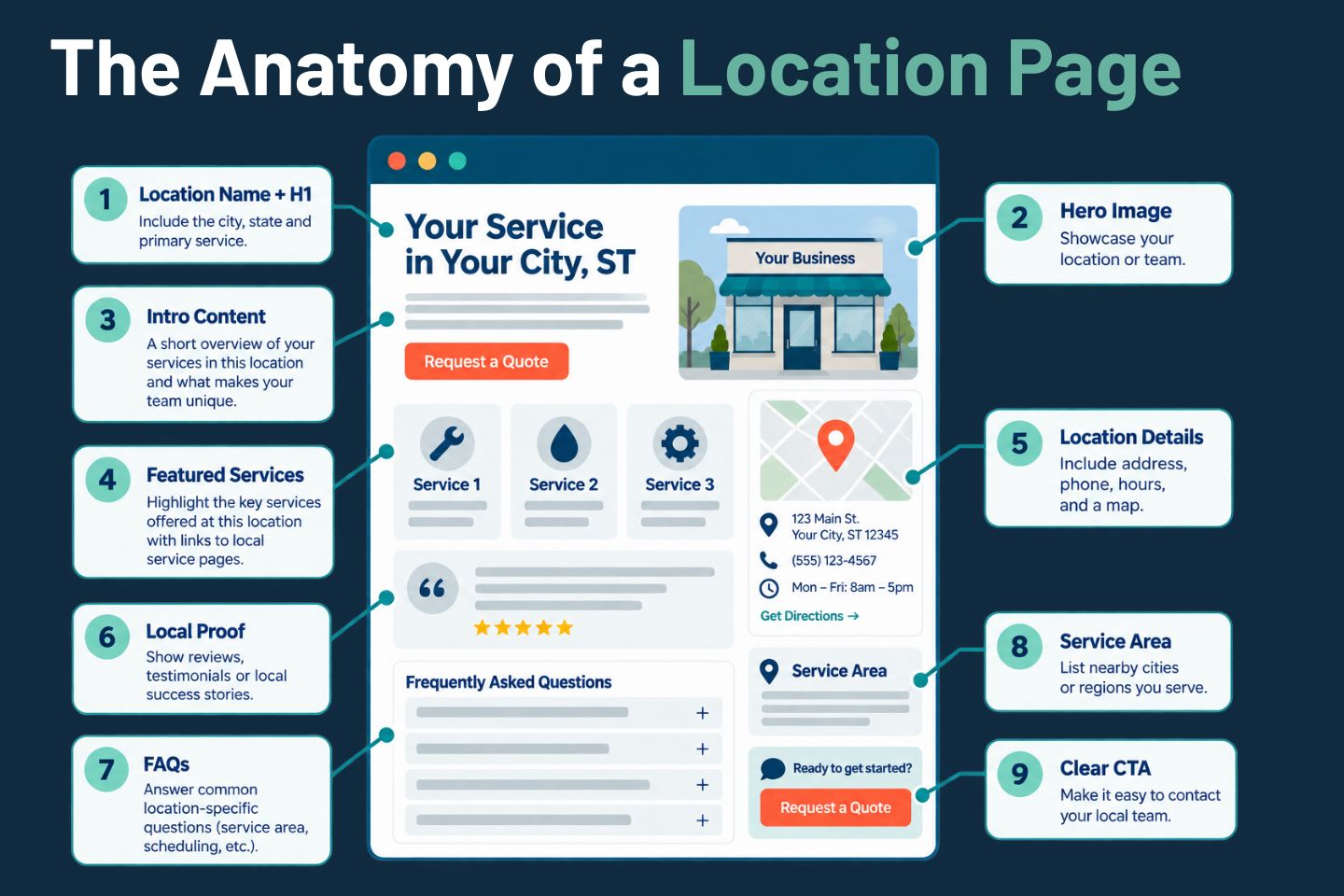
A location page that actually does SEO work has nine components. Most franchise location pages have three or four of them. Here is what the complete version looks like.
Location Name and H1
The page headline should include the city, state, and primary service. “HVAC Repair in Manchester, NH” tells Google and the visitor exactly what this page is about before they read another word. A brand name alone does not do that job.
Hero Image
A photo of the actual location or the actual team. Not a stock image of a generic storefront. Customers evaluating a local service business are forming an impression of whether this feels like a real, established operation in their community. A real photo of a real place does that. Stock does not.
Intro Content
A short overview of what this location offers and what makes this specific team worth calling. This is where locally specific language lives: the neighborhoods served, any specialties particular to this franchise owner, the years the location has been operating. This content is what separates a real location page from a template with a swapped address.
Featured Services
The key services available at this location, linked to individual local service pages where they exist. Not a copy of the national services list. The services this franchisee actually offers, described in the language a local customer would use to search for them.
Location Details
Address, phone number, hours, and an embedded map. These need to match the GBP exactly. Any discrepancy between the location page and the GBP sends a consistency signal Google does not reward.
Local Proof
Reviews, testimonials, or local success stories specific to this location. A national testimonial page does not serve this purpose. The social proof that converts a local customer is proof that someone in their area had a good experience with this specific team.
FAQs
Location-specific questions about service area coverage, scheduling, what to expect, and anything else that commonly comes up for customers in this market. These can also capture long-tail local search queries that the main page content does not directly target.
Service Area
A list of the nearby cities, towns, or regions this location serves. Written out in plain language, not just embedded in a map widget. “Serving Manchester, Concord, Nashua, and the greater Merrimack Valley” gives Google geographic signals that a map pin alone does not.
Clear CTA
A direct path to contact or book, visible without scrolling, present at the top and bottom of the page. A “Request a Quote” or “Book a Service” button that goes somewhere fast. Not a general contact page. Not a phone number buried in the footer.
National Content and Local Content: Your Franchise Website Needs Both
Most franchise websites are built with one of these and not the other. Brand-level content with no real location pages, or location pages with no supporting national presence. Both fail franchisees in different ways.
National Content Builds Brand Authority
Brand-level service pages, category overviews, and educational content on the franchise website do several things that location pages cannot. They build national and regional organic visibility for the brand as a whole. They give prospective customers who discover the brand through a broad search a place to understand what the franchise offers before they find their local location. They educate homeowners or buyers about the service category in a way that supports the purchase decision. And they support franchise development by giving prospective franchisees a credible brand presence to evaluate. National content is the foundation that gives individual location pages something authoritative to connect to.
Local Content Drives the Calls
National content builds awareness. Local content drives conversions. A franchisee location page with the city, services, team, and service area described specifically is what ranks in the map pack, appears in local organic results, and gives the customer who is ready to book a reason to call this specific location. Local content includes the unique page for each franchisee location, the services offered at that location highlighted specifically, the city and service area described in plain language, and the local proof, reviews, team photos, local success stories, that confirms to a nearby customer this is a real local business worth calling.
The two levels work together. National content builds the domain authority and brand signals that help individual location pages rank. Local content builds the geographic specificity that national pages cannot have. A franchise website that has both is doing work at every stage of the customer search journey, from brand discovery to local conversion.

Service Pages at Two Levels
Home service franchise websites need service content at the brand level and at the location level, and those pages should not compete with each other.
Brand-level service pages, a roofing page, a plumbing page, an HVAC page, support national and regional organic search visibility and give the brand authority in each service category. They are written for the homeowner who finds the brand through a broad search and wants to understand what the franchise offers.
Location-level service content serves a different purpose. It supports the map pack visibility and local organic rankings that drive calls to individual franchisees. A homeowner searching “roof replacement in [city]” needs to find the franchisee serving that market, not the brand’s national roofing page. Getting this architecture right, so each level of service content supports rather than competes with the other, is one of the more technically important decisions in franchise website design. The multi-location SEO playbook covers the structural approach in depth.
The Booking and Quote Path
Home service customers have high intent and low patience for friction. An online booking tool or instant quote form that lets a homeowner describe their job and submit a request in under two minutes converts more of that traffic into leads than a generic contact form. For franchise systems where each franchisee manages their own scheduling, a centrally managed lead routing system that captures the request at the brand level and delivers it to the right franchisee is the cleanest solution. For systems where franchisees manage their own booking, embedding a consistent booking tool across all location pages, one the franchisor configures and the franchisee does not have to set up independently, produces more consistent results.
The Franchise Development Section
A prospective franchisee evaluating a home service franchise brand is asking different questions than a homeowner looking for a plumber. They want to know whether the brand has real market traction, what the support infrastructure looks like, what existing franchisees say about their experience, and whether the investment thesis makes sense. That audience needs its own section of the website, not a tab buried in the navigation that links to a PDF inquiry form.
The consumer-facing website is doing more work in franchise development than most franchisors realize. A prospective franchisee who finds strong local visibility for existing locations, well-built location pages, and a professional brand presentation across the entire site is forming a positive impression before they ever read the franchise development page. We have covered the relationship between consumer web presence and franchise development in more depth in our piece on why your website matters to franchise development.
How Trebletree Can Help
We design and build home service franchise websites with the location page architecture, service content structure, and franchisee systems that make the whole thing actually work at scale. If you are a home service franchisor whose website is not producing consistent location-level visibility or whose franchisees are not getting the calls they should be, we can show you where the gaps are.
See how we approach franchise website design
Frequently Asked Questions
What makes a home service franchise location page effective?
A location page that works for both local search and homeowner conversion includes the franchisee’s specific service area in plain geographic language, the services offered at that location with enough detail to match specific searches, a direct booking or quote path that does not require more than two steps, and contact information that is impossible to miss. Generic location pages that list only an address and phone number do very little for local search visibility and convert poorly compared to pages with real service and geographic content.
Should home service franchise location pages be managed centrally or by franchisees?
The core page architecture and brand information should be managed centrally. Local content, the specific service areas covered, any local differentiators, updated photos, and any locally relevant additions, can be contributed by franchisees within a structured framework. The franchisors who get the best results give franchisees a way to add local content without giving them unconstrained access to page structure and brand elements they might inadvertently break.
How do service pages at the brand level and location level work together?
Brand-level service pages support national and regional organic visibility and establish brand authority in each service category. Location-level service content supports map pack visibility and local organic rankings for individual franchisees. The key is making sure the two levels are structured so they complement each other rather than competing for the same searches. A brand roofing page and a franchisee roofing location page can both rank if they are optimized for different geographic scopes and levels of search specificity.
How much does a home service franchise website cost?
The range is wide depending on the number of locations, the complexity of the booking and routing systems, and how much custom development the franchise system requires. Our piece on franchise website costs covers what drives the range and what franchisors should expect to invest at different scales.
What should the franchise development section of a home service franchise website include?
Investment range and startup costs, territory structure and exclusivity, training and support program details, an honest description of what running the franchise involves operationally, and stories from existing franchisees that describe their experience specifically rather than generally. Prospective franchisees are evaluating a significant financial decision and respond to specificity and transparency rather than benefit language and enthusiasm.