


Bottom Line Up Front: Why Franchise Brands Are Invisible to AI
- Strong search visibility doesn’t automatically translate to visibility in ChatGPT, Gemini, Perplexity, or AI Overviews
- Franchise websites create a unique challenge when services, locations, and content exist in separate buckets without clear relationships between them
- AI visibility comes down to three things: retrieval, understanding, and selection
- There’s no 90-day shortcut, but you can establish the foundation, fix critical gaps, and begin building the content and authority that drive ongoing growth
Franchise brands have spent years building their visibility in search.
They’ve invested in SEO. Built hundreds or thousands of location pages. Created service and product content. Managed local listings. Earned backlinks. Optimized Google Business Profiles.
Then someone asks ChatGPT, Gemini, Perplexity, or Google an AI-powered question about their industry.
And the brand barely exists.
Instead, the answer mentions competitors, publishers, Reddit threads, industry websites, directories, or brands with a fraction of their real-world footprint.
That’s a frustrating place to be. But it’s also not particularly surprising.
The web infrastructure that helped franchise brands scale wasn’t necessarily built to help AI systems understand them.
And that’s becoming a problem.
This is where franchise GEO comes in.
Call it Generative Engine Optimization (GEO), Answer Engine Optimization (AEO), AI Optimization (AIO), or simply AI search optimization. The industry hasn’t exactly settled on the terminology yet. But we’re all trying to solve essentially the same problem: Is your brand visible when people use LLMs and AI-powered search engines to find information, compare options, and make decisions?
For franchise brands, that means thinking about AI visibility at both the brand and local level, and making sure AI systems can find, understand, and trust the information that connects the two.
A Big Brand Can Still Be Invisible to AI
Traditional search visibility and AI visibility overlap, but they aren’t the same thing.
Ranking well in Google certainly helps. Strong technical SEO, authoritative content, backlinks, brand mentions, structured data, and a healthy local search presence all create signals that can contribute to AI visibility.
But AI search introduces another question:
Can a machine easily understand, retrieve, and trust the information you’ve published enough to use it when constructing an answer?
That’s where many franchise brands run into trouble.
Think about the architecture of a typical franchise website.
There may be:
- Hundreds of templated location pages
- Nearly identical content across those locations
- Corporate pages competing with local pages
- Important service information buried several clicks deep
- Location data coming from a third-party platform
- Inconsistent structured data
- Weak relationships between services and the locations that actually provide them
- Blog content created over many years without a cohesive topical strategy
- Important brand information scattered across multiple domains and third-party websites
Humans can often piece that ecosystem together, but machines can have trouble when hundreds or even thousands of pages are at the same hierarchical level.
AI Visibility Has Three Separate Problems
When we’re investigating why a brand isn’t appearing in AI search, I like to separate the problem into three layers:
Retrieval. Understanding. Selection.
They’re related, but they’re not interchangeable.
1. Retrieval: Can AI systems find the right information?
Before your content can influence an AI-generated answer, the systems supporting that experience need access to useful information about your brand.
That immediately brings technical SEO back into the conversation.
- Can important pages be crawled and indexed?
- Are canonical signals correct?
- Is important information hidden behind JavaScript or embedded in third-party experiences?
- Are pages orphaned or buried deep within the architecture?
- Are there thousands of low-value URLs consuming crawl resources while strategically important pages receive little internal support?
- AI optimization doesn’t eliminate technical SEO.
- It makes good technical SEO even more important.
2. Understanding: Can machines figure out what your brand actually does?
Being crawlable doesn’t mean being understandable. This is where franchise architecture becomes particularly interesting.
Ideally, the relationships across the website should be extremely clear:
Brand → Products/Services → Locations → Local Attributes
- The corporate website establishes the brand.
- Core product and service pages establish what the organization offers and what it knows about.
- Location pages establish where those offerings are available.
- Supporting content answers the questions surrounding those topics.
- Internal links reinforce those relationships.
- Structured data provides additional machine-readable context where appropriate.
- External sources help corroborate the information.
When those connections are weak, machines have to do significantly more work to understand the brand. That’s rarely a good strategy.
3. Selection: Why should an AI system use you in the answer?
This is the hardest part.
You can have a technically excellent website and perfectly understandable content and still not become the source selected for an AI-generated response.
AI systems have an enormous amount of information available to them.
Your goal isn’t simply to publish an answer. You need to build enough authority around a topic that your brand becomes a credible source within the broader information ecosystem.
That authority doesn’t live exclusively on your website. It comes from the combination of your content, links, mentions, citations, reviews, local presence, industry coverage, expert signals, and the consistency with which other sources reinforce what you’re saying.
This is one of the biggest shifts brands need to make when thinking about GEO.
Your website is no longer the entire optimization environment.
The rest of the web matters too.
Why Franchise Websites Have an Architecture Problem
Franchise SEO has always required balancing national and local visibility.
AI search makes that relationship even more important.
Consider a franchise with 500 locations.
A traditional website architecture might include a corporate homepage, category pages, service pages, educational content, and 500 location pages.
But what relationship exists between all of those pages?
- Do location pages explain which services are actually available there?
- Does supporting content connect back to authoritative commercial pages?
- Are locations clearly identified as part of the larger organization?
- Does structured data accurately reflect those relationships?
- Does the same information appear consistently across the website, Google Business Profiles, directories, social profiles, industry websites, and other third-party sources?
Too often, the answer is: sort of.
That’s not enough anymore.
The goal shouldn’t be to create more pages. It should be to create a stronger knowledge architecture.
Every important page should have a purpose within that architecture. And every important entity and relationship should be easy to understand.
So, Can You Really Fix AI Visibility in 90 Days?
No.
At least, that’s not how I would frame it.
There is no switch you can flip that suddenly makes a brand visible in AI search.
There isn’t a schema type that guarantees citations.
There isn’t an AI content template that solves the problem.
And there certainly isn’t an llms.txt file that’s going to magically transform your visibility.
Building authority takes time.
Building a meaningful content ecosystem takes time.
Getting technical changes implemented across a large franchise website takes time.
Seeing search engines crawl, process, and respond to those changes takes time.
But 90 days is enough to completely change the direction of the program.
If a franchise brand came to us tomorrow with weak AI visibility, here’s how we would approach the first three months.
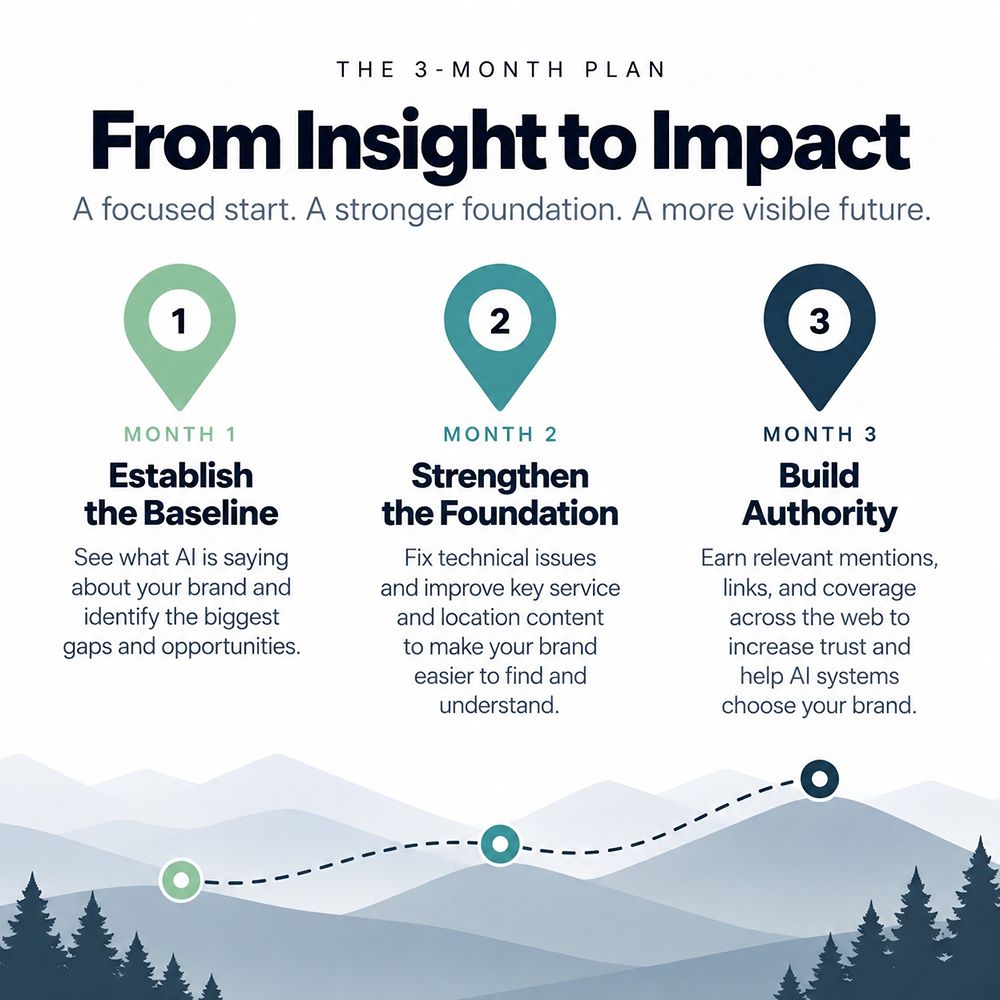
Month 1: Establish the Baseline and Find the Gaps
Before we change anything, we need to understand what AI systems are actually saying about your brand today.
That starts with measurement.
We establish AI visibility tracking around the prompts that matter to the business. Not hundreds of random questions generated by a tool, but a strategic prompt set built around your products or services, customer problems, comparison queries, local intent, and the questions that can actually influence a customer decision. Our current tracking partner is Peec.
Then we start asking:
- Are you appearing at all?
- How often are you mentioned?
- Which competitors appear instead?
- What does AI say about your brand?
- Is that information accurate?
- Which sources are being cited?
- Are those sources your website, third-party publishers, directories, forums, competitors, or something else?
- What topics consistently trigger your brand?
- Where are the biggest visibility gaps?
This becomes our baseline.
But AI visibility tracking only tells us what is happening.
The next step is figuring out why.
That’s where a comprehensive franchise GEO audit comes in.
We look at the entire visibility picture, including the technical foundation of the website, content, site architecture, structured data, internal linking, indexation, crawlability, location architecture, entity signals, backlinks, brand mentions, citations, local presence, and broader off-site authority.
For franchise brands, we pay particular attention to the relationship between corporate, service, content, and location pages. A site can have thousands of indexable URLs and still do a poor job communicating which pages matter and how all of those entities relate to each other.
We also look beyond the website.
- Who has authority in your space?
- Which sources are AI systems already relying on?
- Where are competitors earning mentions that you aren’t?
- What does their backlink and citation profile look like?
- Where does your brand already have authority that isn’t being fully leveraged?
By the end of the first month, we should have much more than a list of GEO recommendations. We should have a prioritized roadmap connecting AI visibility problems to the technical, content, and authority signals that can actually change them.
Month 2: Strengthen the Technical and Content Foundation
Now we start fixing what we found.
And this is where GEO and SEO become deeply interconnected.
If AI systems can’t efficiently retrieve and understand your website, creating more content isn’t going to solve the underlying problem.
Technical priorities will be different for every franchise brand, but this can include improving crawlability and indexation, cleaning up canonical signals, strengthening internal linking, correcting structured data, improving page hierarchy, addressing JavaScript rendering issues, and making the relationship between corporate, service, content, and location pages much clearer.
For a franchise website, architecture matters enormously.
We don’t want 500 location pages effectively sitting beside a service page with no meaningful relationship between them. We want the architecture and internal linking to help establish that relationship.
At the same time, we begin addressing the content gaps uncovered during the audit.
That doesn’t mean publishing as much content as possible. It means identifying where the brand has a legitimate opportunity to provide a better answer.
Sometimes that’s a new piece of content.
Sometimes it’s strengthening a core service or product page.
Sometimes it’s improving an existing article that already has rankings, links, and history but isn’t structured around the way customers now search for information.
Sometimes it’s adding valuable local information to a location template that’s currently little more than a name, address, phone number, and duplicated corporate copy.
The objective is to build a connected content ecosystem around the topics where the brand has genuine expertise.
And importantly, content strategy doesn’t end in Month 2.
This is where we establish the roadmap. From here, content development becomes an ongoing part of the program.
Month 3: Start Closing the Authority Gap
By Month 3, we’re improving what AI systems can learn from the website.
Now we need to strengthen what the rest of the web says about the brand.
Because authority isn’t something you can manufacture entirely on your own domain.
Remember the third part of our model: selection.
Why should an AI system choose your brand or your content when it has thousands of potential sources available?
This is where we start turning the authority findings from the audit into action.
Look at the websites, publications, directories, communities, experts, and other sources shaping the conversation in your industry.
Then compare that ecosystem with your own presence.
- Where are competitors earning relevant links and mentions?
- Which publications repeatedly appear in AI citations?
- Where should your experts be contributing?
- What proprietary information, data, or expertise could the brand publish that other people would actually want to reference?
- Where are there legitimate opportunities for digital PR, thought leadership, expert commentary, local citations, industry coverage, and authoritative links?
This isn’t about collecting mentions for the sake of collecting mentions.
It’s about strengthening the network of independent sources that reinforce what your brand knows and why it belongs in the conversation.
And just like content, authority building doesn’t end after Month 3.
You continue earning coverage.
You continue building relevant links.
You continue contributing expertise.
You continue strengthening local signals.
You continue creating things worth citing.
Authority compounds.
That’s why it can’t be treated as a one-month campaign.
And Throughout All Three Months: Measure What Changes
The measurement we established in Month 1 stays running.
That’s critical.
We’re not waiting until Day 90 to rerun a handful of prompts and see whether something happened. We’re watching how visibility changes as the program develops.
- Are we appearing for more of our priority prompts?
- Are mentions increasing?
- Are we starting to appear in new topic areas?
- Are different pages from our website being cited?
- Are the sources influencing AI answers changing?
- Are competitors gaining or losing ground?
And we’re looking at those changes alongside traditional SEO data.
- Search Console.
- Rankings.
- Organic visibility.
- Indexation.
- Branded search.
- Local visibility.
- Referral traffic.
- Conversions.
AI visibility doesn’t replace any of those datasets.
It adds another dimension to them.
And because AI search is still evolving quickly, I wouldn’t reduce progress to one proprietary “AI visibility score.”
We need to look at the actual answers, actual citations, actual prompts, and the broader search performance around them.
What Happens After 90 Days?
We keep going.
That’s the less exciting answer, but it’s the right one.
At 90 days, we should have established the baseline, identified the major barriers to visibility, implemented high-priority foundational improvements, started closing important content gaps, and begun strengthening the brand’s authority outside its own website.
But we’re not done.
The technical roadmap continues.
The content roadmap continues.
Authority building continues.
Digital PR continues.
Local optimization continues.
Measurement continues.
And we keep using what we’re learning to determine what comes next.
Maybe we’re seeing visibility improve around one topic but not another.
Maybe a new competitor suddenly starts appearing across our priority prompts.
Maybe we’ve discovered that a handful of third-party sources have an outsized influence on the answers we’re tracking.
Maybe our new content is being indexed and ranking but still isn’t being retrieved by AI systems.
Those aren’t failures.
They’re the next set of questions.
The first 90 days give us the foundation, the data, and the roadmap.
The months that follow are where we compound it.
Don’t “AI Optimize” Your Entire Website
There’s another side to this.
In the rush to appear in AI search, brands are going to overdo it.
We’re already seeing the temptation.
- Create hundreds of question-and-answer pages.
- Turn every heading into a question.
- Add enormous FAQ sections.
- Publish thousands of AI-generated articles.
- Add every possible schema type.
- Rewrite perfectly good copy because someone said AI prefers a certain sentence structure.
That’s NOT a strategy.
And it will make the website worse.
If your GEO program results in awkward content that humans don’t want to read, you’ve optimized for the wrong audience.
The objective isn’t to write for AI.
It’s to make genuinely useful information easier for machines to discover, understand, retrieve, and trust.
There’s an important difference.
Franchise Brands Actually Have an Advantage
For all the challenges I’ve outlined, franchise brands also have something most websites would love to have:
Scale.
Hundreds of physical locations create hundreds of opportunities for local relevance.
Thousands of customers create real-world experience and reviews.
Franchisees create community connections.
The organization accumulates expertise, data, questions, stories, and insights every single day.
The problem isn’t a lack of information.
Usually, it’s that none of it has been organized into a cohesive digital knowledge ecosystem.
That’s the opportunity.
The franchise brands that become highly visible in AI search won’t necessarily be the ones publishing the most content.
They’ll be the ones that make it easiest to understand:
Who they are.
What they know.
What they offer.
Where they offer it.
And why their information should be trusted.
That’s not fundamentally different from what good search optimization has always tried to accomplish.
We’re just optimizing for another way information gets discovered.
Write for humans. Engineer for machines.
That’s the strategy.