

What Makes a Great Family Entertainment Franchise Website
- Get a parent to a booking in a few taps, from any device
- Answer the safety and pricing questions that stall a decision before they have to ask
- Give every venue its own page that ranks and converts in its own local market
- Build one shared template the franchisor controls, with local fields (hours, party packages, events) the franchisee owns
Somewhere right now, a parent is sitting in a car outside a school pickup line, thumb-scrolling for something to do with six kids and a rainy Saturday. They will spend about ninety seconds deciding. If your franchise website makes them hunt for hours, guess at party pricing, or click through a national page to find the nearest venue, they will book the place that made it easy.
That is the design problem in family entertainment. The product is a good time, the buyer is a busy parent, and the decision happens on a phone. Add a franchise structure on top of that, with dozens or hundreds of independently owned venues, and the website becomes one of the most important operating tools in the system.
We have written about the same architecture question for retail franchises and home service franchises. Family entertainment has its own quirks, so here is how we approach it.
Why Family Entertainment Websites Are Built Differently
Most franchise categories sell one thing at a time. A family entertainment venue sells several, and each one has a different buyer moment.
There is the walk-in visit, which is impulsive and depends on hours, pricing, and whether the place is open right now. There is the birthday party, which is planned weeks out and depends on packages, capacity, and food policies. There are group events for schools, scout troops, and corporate outings, which usually start with an inquiry form rather than a checkout. There are memberships and passes, and seasonal programs like camps and holiday events layered on top.
A website that treats all of that as one generic “visit us” experience will underperform. A good one routes each type of visitor to the right path quickly, and it does so at the location level, because a party package at one venue is not automatically available at another.
Start With the Booking Path, Not the Homepage
Most franchise website projects begin with the homepage design. We start with the booking path, because that is where the revenue is.
Map the two or three actions that matter most (book a party, buy tickets or a pass, request a group quote) and work backward. Every one of those should be reachable from any page in a tap or two. The primary button on a location page should never be “Contact Us.” It should be the specific thing a parent came to do.
The second decision is how the booking tool connects to the site. Whether you use an online booking platform, a ticketing system, or a lead form that routes to the venue, the handoff needs to feel like part of the brand, load quickly on a phone, and send the visitor to the correct location’s calendar. A parent who lands on a national booking page and has to pick their venue from a dropdown a second time is one distraction away from leaving.

Keep Brand Pages and Location Pages From Competing
Franchise sites get into trouble when the national pages and the local pages target the same searches. The brand’s attractions page ends up competing with the individual venue pages, and neither one ranks well.
The cleaner approach splits the jobs.
National pages handle the brand story, the attractions overview, party and group information at the system level, and franchise development. They build authority for the brand as a whole.
Location pages handle everything a visitor needs in their own market, and they are the pages that win local searches like “kids birthday party places near me.” Our family entertainment franchise SEO guide covers how those local searches work. The design job is making sure the site structure supports them, with shallow URLs, a location finder that actually works on a phone, and internal links that push authority down to each venue page.
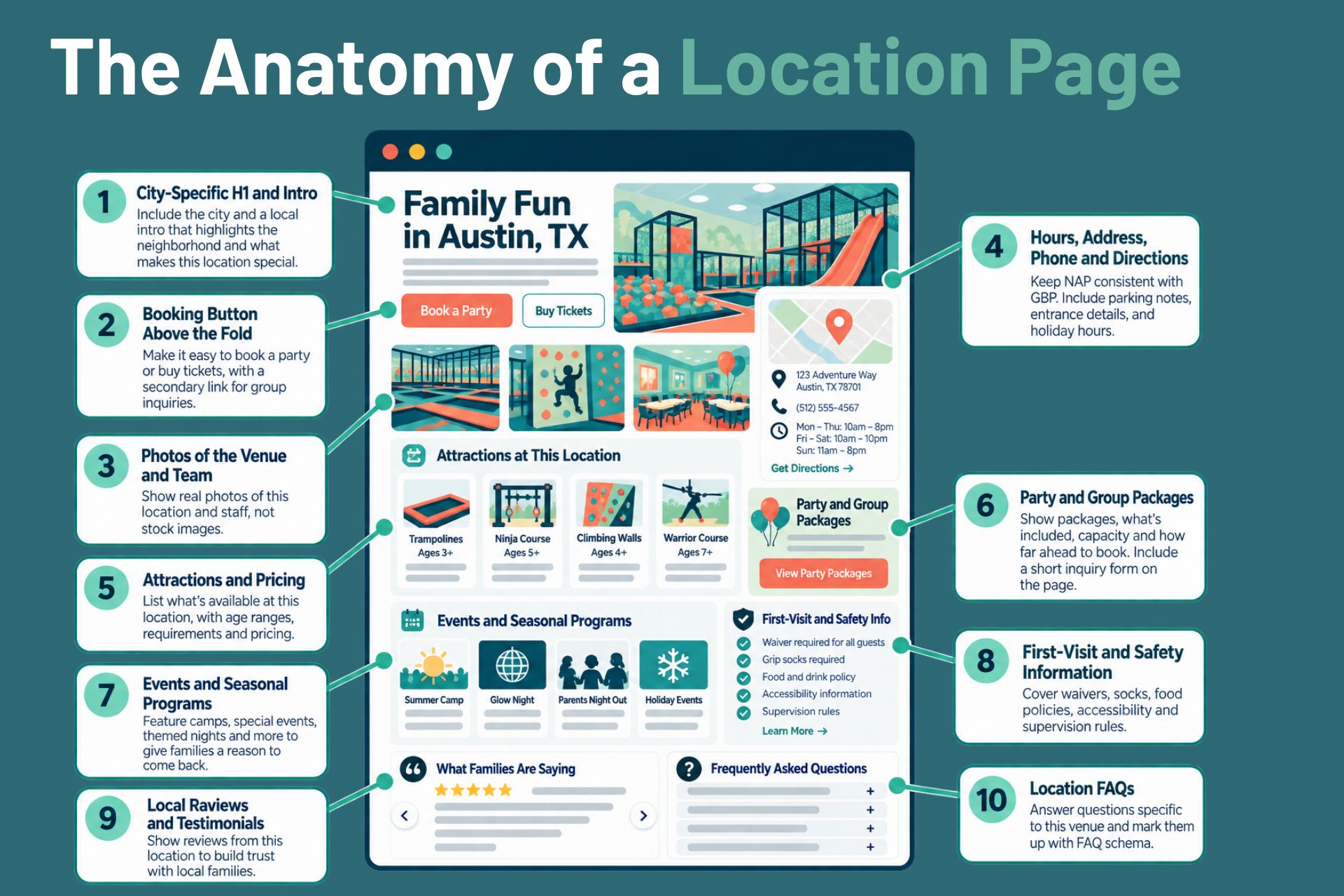
The Anatomy of a Family Entertainment Location Page
The location page is the most valuable page on the site. It is where a search result turns into a booking. Here is what belongs on it, in roughly the order a parent needs it.
Design for the Phone in the Parking Lot
Family entertainment websites tend to be image-heavy, and image-heavy sites tend to be slow. Both facts matter, because most of your traffic arrives on a mobile connection from someone already on the move.
Compress every image, lazy-load anything below the fold, and test the location pages on a mid-range phone over cellular data, not on the office Wi-Fi. Make tap targets large, keep forms short, and put the phone number behind a click-to-call link. A gorgeous site that takes six seconds to load loses the parent before the first attraction appears.

Give Franchisees Control Without Losing the Brand
Franchisees know their venues best, and they are the ones who will notice when the holiday hours are wrong. A good build gives them a controlled way to edit the things that change (hours, events, party availability, photos, local promotions) while locking the things that should not (layout, navigation, fonts, brand messaging, legal language).
That permission structure is a design decision, and it is much easier to build in from the start than to bolt on after launch. It also solves a quiet franchise problem. When owners can keep their own page current in two minutes, they stop asking corporate for changes, and the pages stay accurate. You can see how we approach that on our franchise web design page, and our guide to what a franchise website costs breaks down where the budget goes.
Keep Franchise Development in Its Own Lane
A family entertainment brand is also selling a business opportunity. Prospective franchisees have different questions than parents, and mixing the two audiences on the same pages muddies both.
Give franchise development its own section with its own navigation entry, its own landing pages, and its own inquiry path. It should be easy to find for an investor and invisible to a parent booking a party.
Plan for AI Search From the Start
Parents increasingly ask AI assistants for party ideas and things to do nearby. Those answers pull from clear, well-structured, location-specific pages, which is exactly what a well-built franchise site produces. If you want the deeper story, we wrote about why franchise brands go invisible in AI search and what to do about it.
Building a Family Entertainment Franchise Website With Trebletree
We build franchise websites that hold the brand together while giving every location room to compete locally, and we do the SEO work alongside the build so the structure is ready to rank on day one. If your website is not keeping up with your venue count, let’s talk.
Frequently Asked Questions
How many pages does a family entertainment franchise website need?
It depends on the system, but the core is a homepage, attraction and party pages at the brand level, a location finder, one page per venue, a franchise development section, and supporting content. The location pages are what scale, so the template matters more than the page count.
Should each venue have its own website or a page on the main site?
For most franchises, a page on the main domain is the better choice. It concentrates authority on one site, keeps branding consistent, and gives every venue a stronger starting position in search than a standalone site would.
How do we keep location pages from looking identical?
Design the template with local fields built in, including photos, events, a local intro, reviews, and location FAQs. When those fields are easy for franchisees to fill in, each page becomes distinct without anyone writing hundreds of pages from scratch.
What is the most important thing to get right on a mobile location page?
What is the most important thing to get right on a mobile location page?
Can Trebletree handle the SEO and the website build together?
Yes. Doing both in the same project means site structure, schema, and location page content are planned together, which avoids the rebuild that often follows a design-first launch.