
Article Summary
Your Google Business Profile is often the first impression a potential client gets before they ever walk through your door. For salons, spas, and beauty businesses, that first impression matters more than most. Clients are choosing where to trust you with their appearance, and a polished, complete profile builds that trust before the consultation even starts.
This guide covers the GBP strategies that matter most for beauty businesses, from picking the right category to getting reviews that actually drive bookings. If you need a full walkthrough of GBP basics, start with our complete GBP optimization guide and come back here for the beauty-specific details.
Choose the Right Primary Category
Your primary category is one of the biggest factors in which searches your profile appears for. And in the beauty industry, the options are more specific than most business owners realize.
Google does not have one catch-all “beauty” category. Instead, it offers dozens of categories across hair, nails, skin, spa, and aesthetics. Your primary category needs to match the service clients search for most when they are looking for your business. A more specific category almost always outperforms a broader one for the searches that matter to you.
If you are a dedicated lash studio, your primary category should be “Eyelash salon,” not “Beauty salon.” If you are a nail-only shop, use “Nail salon.” A med spa offering injectables and laser treatments should lead with “Medical spa,” not “Day spa.” The more precisely your primary category describes what you do, the better Google can match you with the right searches.
Once your primary is set, use your secondary categories (you can add up to nine) to capture your other services. A full-service salon might lead with “Hair salon” and add “Nail salon,” “Eyelash salon,” “Waxing hair removal service,” and “Facial spa” as secondaries.
For franchise and multi-location brands, make sure each location’s primary category reflects what that specific location is best known for. If one location focuses on hair and another is a full-service spa, their primary categories should differ.
Beauty and Salon GBP Categories Reference
Google’s category list for this sector is bigger than most people expect. Here is every service-relevant category available to beauty, salon, and spa businesses, organized by type.
Hair
- Hair salon
- Beauty salon
- Hairdresser
- Barber shop
- Hair extension technician
- Hair replacement service
Nails, Lashes, Brows
- Nail salon
- Eyelash salon
- Eyebrow bar
Body Art
- Tattoo shop
- Tattoo artist
- Tattoo and piercing shop
- Tattoo removal service
- Body piercing shop
- Ear piercing service
Spa and Massage
- Day spa
- Spa
- Health spa
- Spa and health club
- Massage spa
- Massage therapist
- Sports massage therapist
- Thai massage therapist
- Foot massage parlor
- Hot bedstone spa
Tanning
- Tanning salon
Hair Removal
- Hair removal service
- Waxing hair removal service
- Laser hair removal service
- Electrolysis hair removal service
Skin, Facial, Aesthetics
- Facial spa
- Skin care clinic
- Esthetics service
- Medical spa
- Make-up artist
- Permanent make-up clinic
Supply/Education (not typical primary for a service business)
- Beautician
- Beauty school
- Beauty supply store
- Beauty product supplier
- Barber school
- Barber supply store
- Massage school
A few notes on this list. “Beauty salon” and “Hair salon” are not interchangeable. They surface for different searches, so pick the one that matches how clients actually look for you. “Beautician” and “Beauty school” also exist in the taxonomy, but those are typically for education and supply businesses, not service providers. And categories like “Massage therapist” vs. “Massage spa” vs. “Sports massage therapist” let you get specific about the type of bodywork you offer.
Write a Description That Books Appointments
You get 750 characters for your business description. That is roughly two short paragraphs. Use them to tell a potential client what you specialize in, who you serve, and what makes you different.
Skip the generic “we provide quality services in a relaxing environment” language. Instead, be specific. Mention your signature services, the neighborhoods or areas you serve, your team’s training or certifications, and anything that sets you apart (organic products, specialized techniques, luxury amenities).
Work in the terms clients actually search for. Someone looking for “balayage near me” or “lash extensions [city name]” should see those words reflected in your description. This is not keyword stuffing. It is matching the language your clients already use.
Structure Your Services Like a Menu
The Services section of your GBP is where you list what you offer, with descriptions and pricing. Think of it like the menu clients browse before they book.
How to Set It Up
Google will suggest service categories based on your business type, but you can also add custom ones. Group your services by type the way you would on your website or printed menu: Hair Services, Nail Services, Skin Treatments, Lash and Brow, Body Treatments, and so on.
For each service, include a brief description, the price (or starting price), and the approximate duration when possible. Clients comparing salons want to know what they will pay and how long it will take.
Keep It Current
Update your services when you add seasonal packages (wedding season prep, holiday packages), limited-time treatments, or new product lines. An outdated services list signals an outdated business.
For franchise brands, the Services section is a good place to maintain brand consistency. Corporate can set a standard list of core services and descriptions while allowing individual locations to add local specials or location-specific offerings.
Use Photos to Sell the Experience
Beauty is visual. Your GBP photos are doing more selling than you might think, and a sparse or outdated gallery sends the wrong message.
What to Post
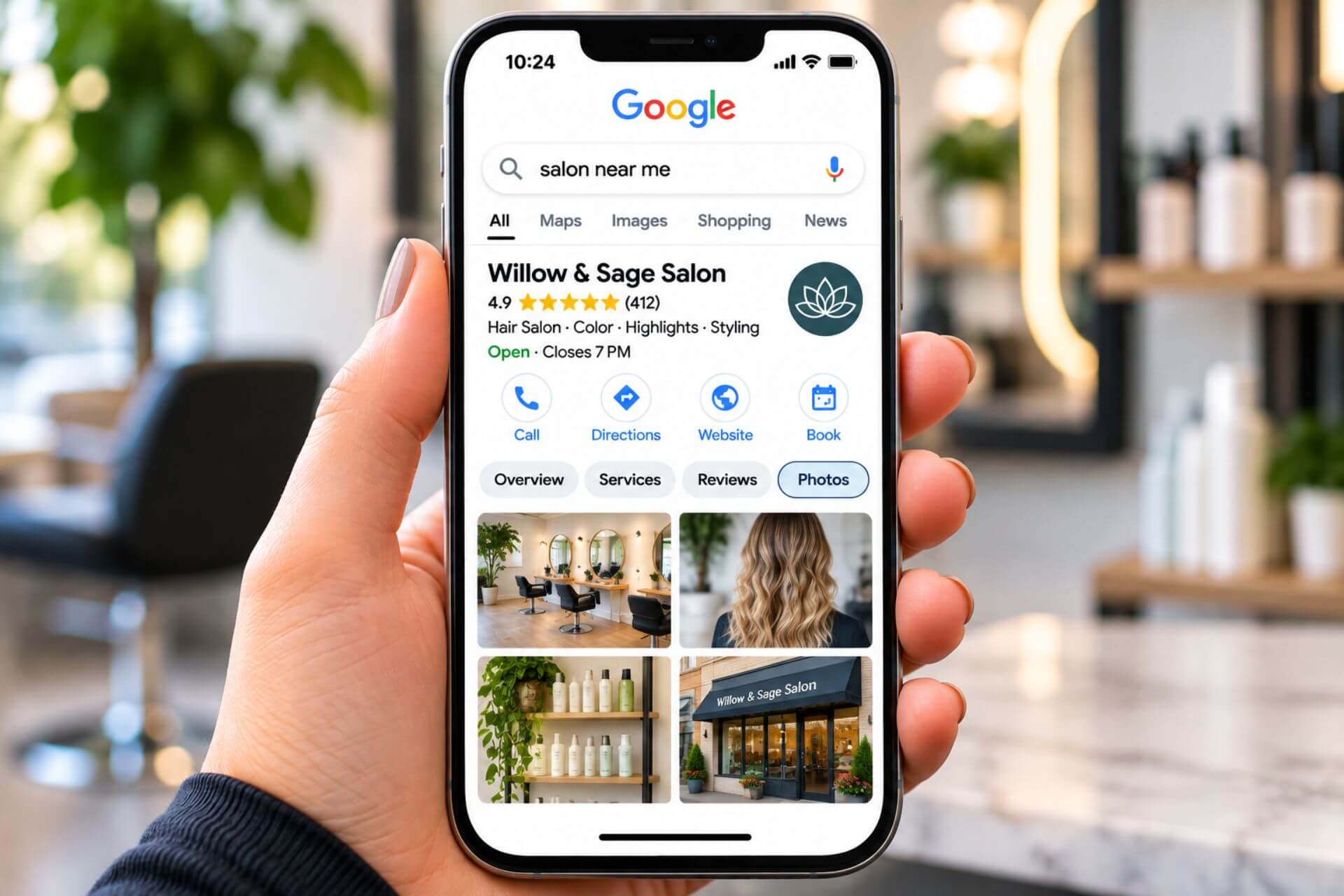
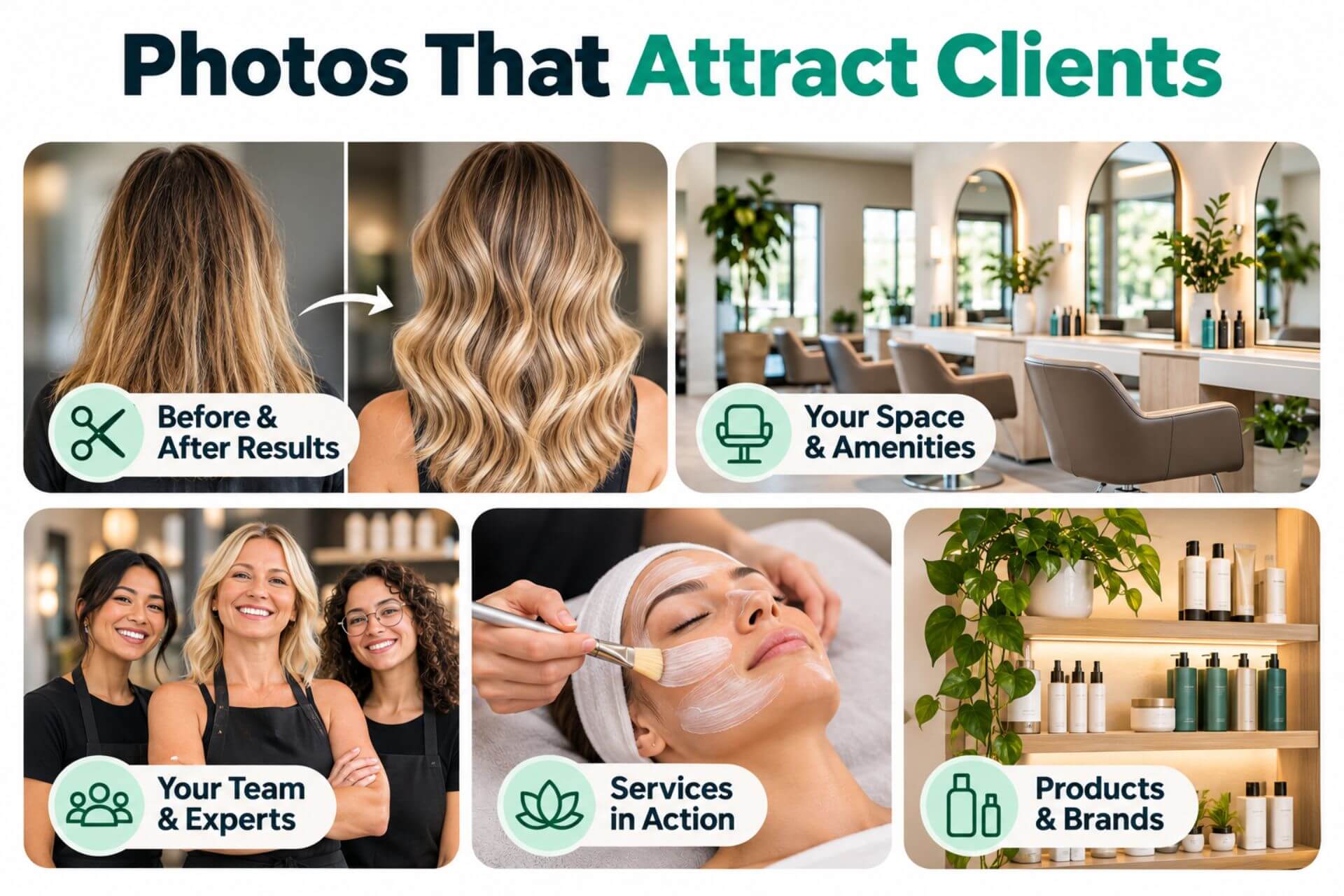
Before-and-after shots are the gold standard for beauty businesses. Hair transformations, nail art, lash sets, facials, color corrections: these are the photos potential clients study when deciding whether to book. Use bright, consistent lighting, and always get client permission before posting.
Your space matters too. Post photos of your reception area, treatment rooms, styling stations, and any amenities (a waiting lounge, product displays, refreshment bar). New clients want to know what walking in will feel like.
Staff and team photos build familiarity. A client who can put a face to a name before they arrive is more comfortable from the start.
How Often to Post
Add fresh photos every two to three weeks. Remove images that are outdated, low quality, or no longer represent your brand. A gallery full of photos from three years ago suggests a business that stopped paying attention.
For recommended dimensions, aim for at least 720px wide for all photos. Cover photos look best at 1080 x 608px, and profile photos at 250 x 250px.
Get Reviews That Mention Specific Services
Reviews matter for every business, but for salons and spas they carry extra weight. Clients are trusting you with their appearance, and reading a detailed review about a specific service is more persuasive than a generic five-star rating.
When and How to Ask
The best time to ask for a review is right when the client sees their result and loves it. That post-reveal moment, when they are checking themselves in the mirror and smiling, is your window.
A few ways to make it easy:
- Send a personalized text within 24 hours with your direct Google review link.
- Place a QR code at the front desk or on appointment cards that links directly to your review form.
- If a client tags you in a social media post, thank them and mention that a Google review would mean a lot.
- Some salon management platforms (Vagaro, Boulevard, Mangomint) can automate review requests after appointments.
You can find your shareable review link in your GBP dashboard under “Get more reviews.”
How to Respond
Respond to every review, positive and negative. For positive reviews, personalize your response (mention their stylist, the service they had, or something specific they said). For negative reviews, respond within a day or two, acknowledge the issue without getting defensive, and invite them to contact you directly to resolve it.
For franchise and multi-location beauty brands, review management at scale is one of the biggest GBP challenges. Each location needs someone monitoring and responding to reviews in a voice that feels personal, not corporate. Consider whether location managers handle their own reviews or whether a centralized team manages responses with templates that can be personalized. Either way, response time and consistency across locations signal a brand that cares. If your brand operates at scale, our franchise beauty marketing resources cover strategies for managing reputation across multiple locations.
Set Up Online Booking
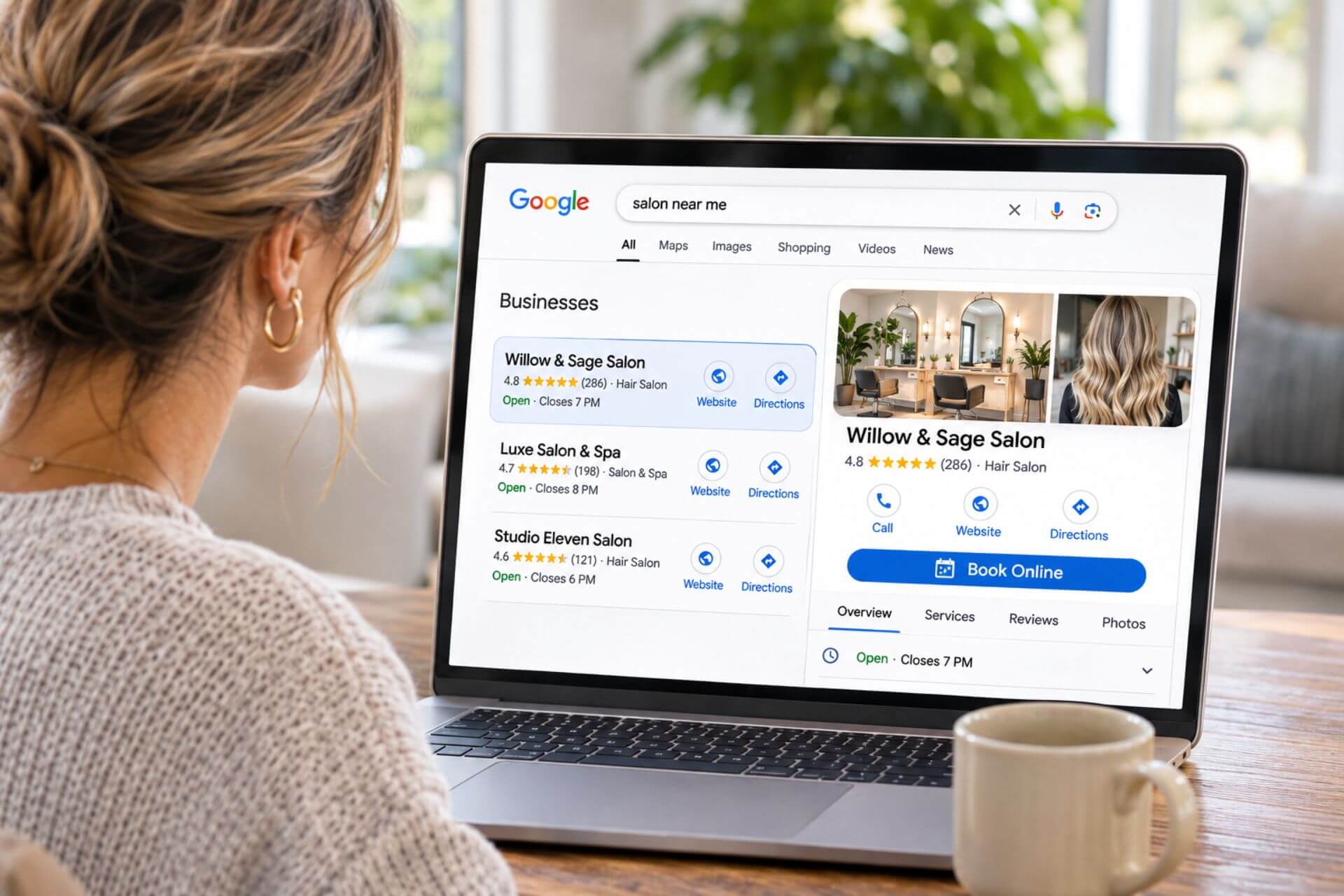
For beauty businesses, the “Book” button on your GBP can be one of your highest-converting features. A client who finds you, likes your photos, reads a good review, and can book without leaving Google is a client you are much less likely to lose.
How to Add It
In your GBP, add your booking URL in the Appointment link field. This creates a “Book” button on your profile. If your booking platform is a Google Reserve partner (Vagaro, Booksy, Square Appointments, StyleSeat, and others), clients may be able to book directly within Google without visiting your website at all.
Keep Availability Accurate
Nothing frustrates a potential client faster than booking a time slot on Google only to find out it is not actually available. Make sure your booking software syncs with what shows on Google, and keep your availability current during holidays, vacation closures, and staffing changes.
Post Strategically
Google Posts let you share updates, offers, and content directly on your profile. For beauty businesses, the best-performing posts tend to be:
- Last-minute openings. A cancellation today with a special for anyone who can grab the slot creates urgency and fills gaps in your schedule.
- Before-and-after results. The same content that works in your photo gallery works as a post, with the added benefit of appearing in your profile’s updates.
- Seasonal promotions. Wedding season packages, holiday gift cards, back-to-school specials, summer skincare bundles. Tie posts to what clients are already thinking about.
- New service announcements. Launching a new treatment, carrying a new product line, or adding a new stylist to the team? Post about it.
Posts expire after six months but are most visible in the first week. Aim for one to two posts per week to keep your profile active without overwhelming it.
Check Your Attributes
GBP attributes are the quick-glance details that show up on your profile: things like “Women-owned,” “Wheelchair accessible,” “Free Wi-Fi,” and “Gender-neutral.” The specific attributes available to you depend on your primary category, so what a Hair Salon sees will differ from what a Medical Spa sees.
Log into your GBP, go to your profile editor, and look through every attribute option available for your category. Check everything that honestly applies. These small details help clients filter and choose, and they give Google more information to match your profile with relevant searches.
Do not assume you know what is available based on another business or another category. Google adds and changes attribute options regularly, and the only reliable way to know what your business can display is to check your own dashboard.
Managing Multiple Locations
If you operate more than one salon or spa, or you are a franchise brand with locations across a market or the country, there are a few GBP considerations that go beyond what a single-location business needs to think about.
Consistency vs. Local Personality
Each location should have its own fully completed GBP with location-specific photos, reviews, and service listings. At the same time, your brand should be recognizable across all of them. A potential client visiting any location’s profile should immediately know it is part of the same brand.
The balance: corporate sets the guardrails (brand name formatting, logo, core service descriptions, response tone), and each location fills in the local details (photos of their space, their team, their neighborhood-specific offers).
Use Location Groups
Google’s Business Profile Manager supports location groups, which let you organize and manage multiple profiles from one dashboard. For franchise brands, this is essential for maintaining oversight without micromanaging each location.
Track Performance by Location
Use GBP Insights to compare how locations perform for searches, photo views, calls, booking clicks, and direction requests. If one location consistently outperforms others, look at what they are doing differently with their profile. Often it comes down to photo frequency, review volume, or how actively they post.
Get Started
Your GBP is one of the most important pieces of your online presence, and for beauty businesses, it is often the thing that tips a client from “maybe” to “booked.” A complete profile with the right category, strong photos, honest reviews, and an easy path to booking does more than any single social media post or ad.
For the full GBP setup walkthrough, start with our GBP optimization guide. And whether you are a single-location salon building your local presence or a franchise brand managing profiles across dozens of markets, we can help. Reach out to learn how we work with local salon and spa businesses and franchise beauty brands..